
metalworkingmag.com
12
'26
Written on Modified on
DMG MORI Expands ULTRASONIC Precision Series With Larger Platform
New ULTRASONIC 80 Precision combines milling and grinding, delivering high accuracy, automation readiness and energy-efficient machining.
en.dmgmori.com
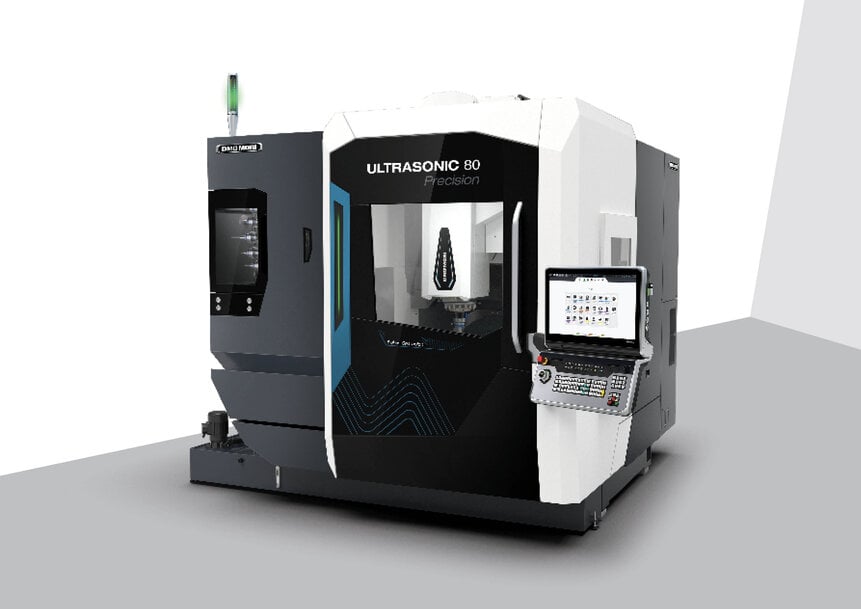
With a working chamber measuring 800 x 600 x 510 mm, the DMG MORI ULTRASONIC 80 Precision can accommodate a wide range of components.
DMG MORI is launching the ULTRASONIC 80 Precision machining center to address the evolving requirements of advanced industrial sectors. This implementation establishes an integrated, high-frequency kinetic machining baseline for technical components, designed to optimize material removal rates, structural part integrity, and equipment versatility within the global digital supply chain.
The continuous standardization of multi-axis machining methods directly impacts the automotive data ecosystem and the localized supply chains of the semiconductor and aerospace sectors. By expanding a uniform ultrasonic-assisted spindle architecture into a larger working envelope, precision manufacturers can shorten production cycles and eliminate the microfractures typically induced when processing advanced engineering materials. This technological harmonization directly addresses the increasing structural complexity of staging units and wafer chucks as well as growing industrial requirements for verifiable sub-micron kinematic positioning.
Kinematic Overplay and Multi-Scenario Process Integration
The structural layout of the ULTRASONIC 80 Precision utilizes a comprehensive kinematics layout featuring an expanded machine workspace measuring 800 by 600 by 510 millimeters. The machine accommodates workpieces up to a maximum diameter of 800 millimeters, a height of 400 millimeters, and an structural weight load capacity of 350 kilograms. To achieve efficient production, the architecture integrates ultrasonic-assisted milling and grinding operations within a single, unmodified material setup, bypassing the cumulative alignment errors caused by shifting parts between standalone machines.
The primary kinematic sequence features a speedMASTER rotational spindle operating at 20,000 revolutions per minute, linked to an inductive actuator with a standardized HSK-63 tool interface. This actuator applies a high-frequency axial vibration over the standard rotational movement of the cutting tool, causing a pulsating micro-engagement between the diamond cutting edge and the workpiece material. This high-frequency contact reduces alternating process forces, controls surface chipping, and optimizes particle rinsing within the active cutting zone, which doubles tool service life when processing hard-brittle substrates like Zerodur glass-ceramics, silicon carbide, and cemented carbides. Simultaneous five-axis positioning is sustained by a rigid swivel rotary table with an angular swing envelope spanning -35 degrees to +110 degrees, complemented by a direct-drive C-axis moving at 300 revolutions per minute to execute continuous axial grinding routines.
Structural Rigidity and Thermally Monitored Precision
Maintaining mechanical alignment under dynamic processing loads requires rigid structural damping and continuous thermal dissipation loops. The physical framework of the system is built from a heavy monolithic machine casting bed and wider cross-axis guideway geometries engineered to isolate structural vibrations. This robust layout guarantees a certified standard positioning accuracy under 5 micrometers, alongside a geometric circularity testing parameter calibrated to 6 micrometers.
Thermal stabilization is maintained by an intelligent closed-loop cooling network that isolates heat-generating subassemblies from the structural casting components. This architecture circulates temperature-controlled fluid through the internal linear guide carriages, the ball screw drive nut assemblies, the rotary table bearings, and the main spindle housing. Minimizing localized thermal expansion prevents geometric deviations during long-cycle operations on temperature-sensitive optical substrates and structural semiconductor components.
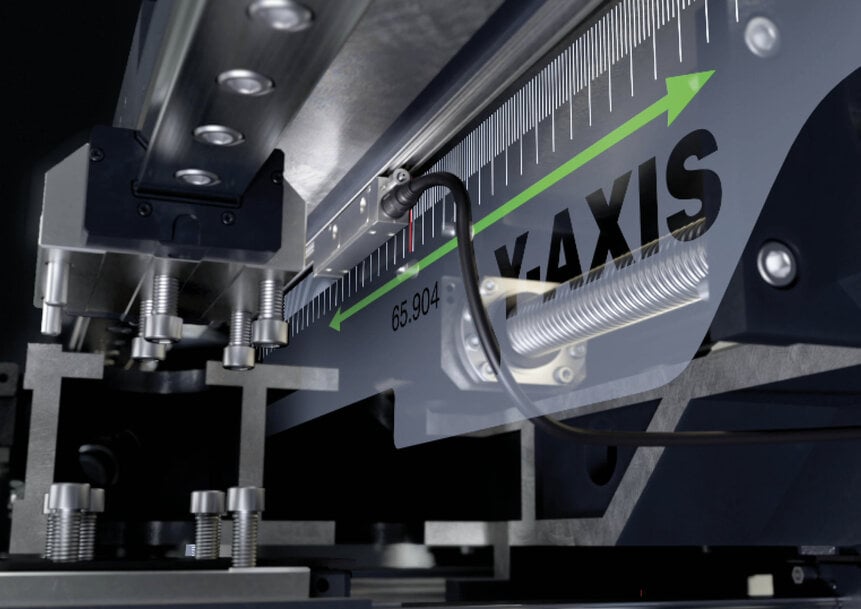
Wide linear guides with precision cooling systems ensure the high positioning accuracy of the DMG MORI ULTRASONIC 80 Precision.
Automated Lifecycle Transformation and Digitized Networking
Transitioning to automated factory workflows alters the capacity profile and structural utilization of the system on the production floor. The machine incorporates a standard 60-position tool changer magazine, expandable to a 120-position configuration to support complex multi-stage milling, drilling, and grinding sequences without manual operator intervention. Operational duty cycles can be scaled through integrated automation interfaces, adapting the machine to work with piece-handling articulated robotics like the Robo2Go Milling and MATRIS networks, or modular pallet-changing carousels including the PH 150 and PH Cell 300 platforms.
The digital framework is built around the ERGOline X control panel running a CELOS X software architecture on a Siemens SINUMERIK ONE numerical control processor. This configuration enables full integration into automated industrial networks, utilizing specialized technology cycles that automatically modulate feed rates and ultrasonic amplitudes based on live spindle load feedbacks. To support resource-efficient manufacturing, the platform features a specialized GREENMODE operational framework that lowers total system energy consumption by more than 20 percent relative to older processing equipment, matching the structural criteria for sustainable industrial infrastructure.
Additional Context:
This section details technical specifications and competitive benchmarking not included in the original product announcement
The launch of the DMG MORI ULTRASONIC 80 Precision introduces a distinct technological benchmark in the multi-axis advanced material processing market, where the machining of complex technical ceramics has traditionally required slow, manual coordinate grinding or specialized ultrasonic toolholder adaptations retrofitted onto standard milling centers. Within the high-capacity five-axis ultrasonic machining category, the system competes directly with advanced high-precision platforms from alternative machine tool builders, including specialized technical ceramic machining centers from Makino and ultra-precision universal milling machines from Hermle.
When evaluated against traditional ultra-precision five-axis machining platforms, such as the Hermle C 32 U or the Makino V33i, the ULTRASONIC 80 Precision establishes an entirely different mechanical material-removal profile for advanced ceramics. While the Hermle C 32 U provides exceptional positional accuracy and rigid gantry structures for standard milling steels and superalloys, it lacks an integrated inductive ultrasonic actuator system within its standard spindle line. Machining hard-brittle materials like silicon carbide on a conventional high-speed milling machine without high-frequency axial vibration forces the cutting tools to plow continuously through the substrate. This conventional approach increases tool wear by up to 200 percent and creates significant microcracking along the edge zones of fragile components.
In the broader international market, specialized competition includes Makino's ultra-precision vertical machining centers, which optimize accuracy through high-rigidity structures and sub-micron linear motor tracks. However, these systems often rely on extremely high-speed conventional grinding cycles (up to 40,000 revolutions per minute) to slowly erode advanced materials. The ULTRASONIC 80 Precision counters this through its hybrid process-integration model, combining 20,000 revolutions per minute rotational speeds with high-frequency axial overlay via the HSK-63 actuator. This kinematic combination reduces overall mechanical process forces, allowing the machine to achieve higher material removal rates than non-ultrasonic equipment while maintaining identical geometric tolerances.
Furthermore, comparing the machine to its smaller predecessor, the ULTRASONIC 60 Precision, highlights how the structural scaling to an 800 by 600 by 510 millimeter envelope changes its target applications. While the smaller 60 series is limited to compact dental implants and minor optical optics, the 80 series expands the workflow to large-scale semiconductor wafer chucks and astronomical mirror stage elements up to 350 kilograms. By integrating automated robotic handling networks directly into the CELOS X and Siemens SINUMERIK ONE open control loop, the machine ensures that real-time adjustments to physical tool contact points occur with minimal latency, establishing a repeatable production benchmark for advanced structural ceramic components.
Edited by Natania Lyngdoh, Induportals editor, assisted by AI.
www.dmgmori.com
DMG MORI is launching the ULTRASONIC 80 Precision machining center to address the evolving requirements of advanced industrial sectors. This implementation establishes an integrated, high-frequency kinetic machining baseline for technical components, designed to optimize material removal rates, structural part integrity, and equipment versatility within the global digital supply chain.
The continuous standardization of multi-axis machining methods directly impacts the automotive data ecosystem and the localized supply chains of the semiconductor and aerospace sectors. By expanding a uniform ultrasonic-assisted spindle architecture into a larger working envelope, precision manufacturers can shorten production cycles and eliminate the microfractures typically induced when processing advanced engineering materials. This technological harmonization directly addresses the increasing structural complexity of staging units and wafer chucks as well as growing industrial requirements for verifiable sub-micron kinematic positioning.
Kinematic Overplay and Multi-Scenario Process Integration
The structural layout of the ULTRASONIC 80 Precision utilizes a comprehensive kinematics layout featuring an expanded machine workspace measuring 800 by 600 by 510 millimeters. The machine accommodates workpieces up to a maximum diameter of 800 millimeters, a height of 400 millimeters, and an structural weight load capacity of 350 kilograms. To achieve efficient production, the architecture integrates ultrasonic-assisted milling and grinding operations within a single, unmodified material setup, bypassing the cumulative alignment errors caused by shifting parts between standalone machines.
The primary kinematic sequence features a speedMASTER rotational spindle operating at 20,000 revolutions per minute, linked to an inductive actuator with a standardized HSK-63 tool interface. This actuator applies a high-frequency axial vibration over the standard rotational movement of the cutting tool, causing a pulsating micro-engagement between the diamond cutting edge and the workpiece material. This high-frequency contact reduces alternating process forces, controls surface chipping, and optimizes particle rinsing within the active cutting zone, which doubles tool service life when processing hard-brittle substrates like Zerodur glass-ceramics, silicon carbide, and cemented carbides. Simultaneous five-axis positioning is sustained by a rigid swivel rotary table with an angular swing envelope spanning -35 degrees to +110 degrees, complemented by a direct-drive C-axis moving at 300 revolutions per minute to execute continuous axial grinding routines.
Structural Rigidity and Thermally Monitored Precision
Maintaining mechanical alignment under dynamic processing loads requires rigid structural damping and continuous thermal dissipation loops. The physical framework of the system is built from a heavy monolithic machine casting bed and wider cross-axis guideway geometries engineered to isolate structural vibrations. This robust layout guarantees a certified standard positioning accuracy under 5 micrometers, alongside a geometric circularity testing parameter calibrated to 6 micrometers.
Thermal stabilization is maintained by an intelligent closed-loop cooling network that isolates heat-generating subassemblies from the structural casting components. This architecture circulates temperature-controlled fluid through the internal linear guide carriages, the ball screw drive nut assemblies, the rotary table bearings, and the main spindle housing. Minimizing localized thermal expansion prevents geometric deviations during long-cycle operations on temperature-sensitive optical substrates and structural semiconductor components.
Wide linear guides with precision cooling systems ensure the high positioning accuracy of the DMG MORI ULTRASONIC 80 Precision.
Automated Lifecycle Transformation and Digitized Networking
Transitioning to automated factory workflows alters the capacity profile and structural utilization of the system on the production floor. The machine incorporates a standard 60-position tool changer magazine, expandable to a 120-position configuration to support complex multi-stage milling, drilling, and grinding sequences without manual operator intervention. Operational duty cycles can be scaled through integrated automation interfaces, adapting the machine to work with piece-handling articulated robotics like the Robo2Go Milling and MATRIS networks, or modular pallet-changing carousels including the PH 150 and PH Cell 300 platforms.
The digital framework is built around the ERGOline X control panel running a CELOS X software architecture on a Siemens SINUMERIK ONE numerical control processor. This configuration enables full integration into automated industrial networks, utilizing specialized technology cycles that automatically modulate feed rates and ultrasonic amplitudes based on live spindle load feedbacks. To support resource-efficient manufacturing, the platform features a specialized GREENMODE operational framework that lowers total system energy consumption by more than 20 percent relative to older processing equipment, matching the structural criteria for sustainable industrial infrastructure.
Additional Context:
This section details technical specifications and competitive benchmarking not included in the original product announcement
The launch of the DMG MORI ULTRASONIC 80 Precision introduces a distinct technological benchmark in the multi-axis advanced material processing market, where the machining of complex technical ceramics has traditionally required slow, manual coordinate grinding or specialized ultrasonic toolholder adaptations retrofitted onto standard milling centers. Within the high-capacity five-axis ultrasonic machining category, the system competes directly with advanced high-precision platforms from alternative machine tool builders, including specialized technical ceramic machining centers from Makino and ultra-precision universal milling machines from Hermle.
When evaluated against traditional ultra-precision five-axis machining platforms, such as the Hermle C 32 U or the Makino V33i, the ULTRASONIC 80 Precision establishes an entirely different mechanical material-removal profile for advanced ceramics. While the Hermle C 32 U provides exceptional positional accuracy and rigid gantry structures for standard milling steels and superalloys, it lacks an integrated inductive ultrasonic actuator system within its standard spindle line. Machining hard-brittle materials like silicon carbide on a conventional high-speed milling machine without high-frequency axial vibration forces the cutting tools to plow continuously through the substrate. This conventional approach increases tool wear by up to 200 percent and creates significant microcracking along the edge zones of fragile components.
In the broader international market, specialized competition includes Makino's ultra-precision vertical machining centers, which optimize accuracy through high-rigidity structures and sub-micron linear motor tracks. However, these systems often rely on extremely high-speed conventional grinding cycles (up to 40,000 revolutions per minute) to slowly erode advanced materials. The ULTRASONIC 80 Precision counters this through its hybrid process-integration model, combining 20,000 revolutions per minute rotational speeds with high-frequency axial overlay via the HSK-63 actuator. This kinematic combination reduces overall mechanical process forces, allowing the machine to achieve higher material removal rates than non-ultrasonic equipment while maintaining identical geometric tolerances.
Furthermore, comparing the machine to its smaller predecessor, the ULTRASONIC 60 Precision, highlights how the structural scaling to an 800 by 600 by 510 millimeter envelope changes its target applications. While the smaller 60 series is limited to compact dental implants and minor optical optics, the 80 series expands the workflow to large-scale semiconductor wafer chucks and astronomical mirror stage elements up to 350 kilograms. By integrating automated robotic handling networks directly into the CELOS X and Siemens SINUMERIK ONE open control loop, the machine ensures that real-time adjustments to physical tool contact points occur with minimal latency, establishing a repeatable production benchmark for advanced structural ceramic components.
Edited by Natania Lyngdoh, Induportals editor, assisted by AI.
www.dmgmori.com
