
metalworkingmag.com
15
'26
Written on Modified on
Nidec Machine Tool to Launch MPLJ Series
With its unique MP Scale that adopts an electromagnetic induction method, this new series realizes a position detection accuracy of ±2.5μm/m with a maximum stroke coverage of 255m.
www.nidec.com
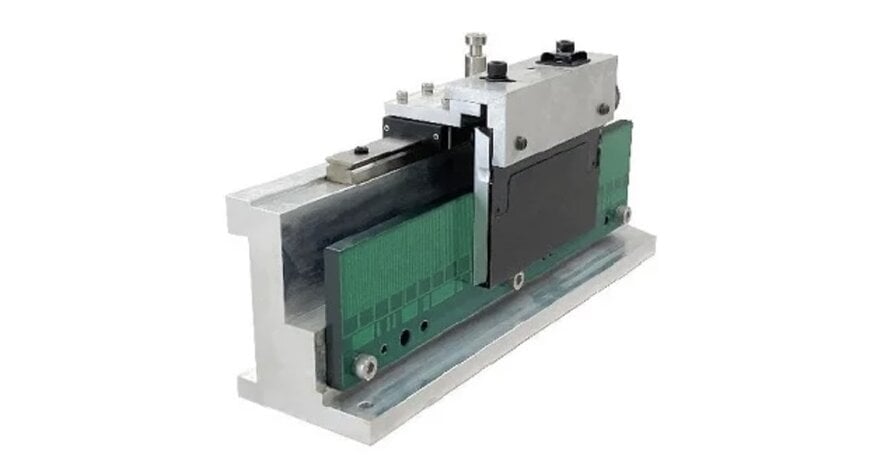
Nidec Machine Tool Corporation has announced the launch of its MPLJ series of linear-type, high-accuracy position detectors developed for large machine tools and extended logistics transport equipment. Utilizing a proprietary MP Scale configured with an electromagnetic induction method, the series delivers a position detection accuracy of ±2.5 μm/m while supporting a maximum stroke length of up to 255 m.
Modular Scale Configurations and Asset Maintenance
As machine tools, automated transport devices, and structural gantries expand in scale, industrial users require linear encoders capable of accommodating long axes while reducing wiring complexity, eliminating startup homing sequences, and minimizing electrical maintenance overheads. The MPLJ series addresses these engineering, manufacturing, and maintenance requirements to optimize long-axis position tracking.
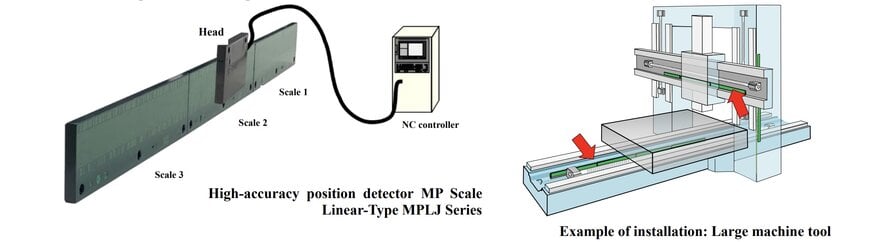
To achieve its maximum stroke coverage of 255 m, the platform employs a modular connected structure. This layout links standard-length scale segments manufactured in 1,000 mm, 750 mm, 500 mm, and 250 mm increments. Utilizing discrete, standard-length segments simplifies transport logistics and field installation workflows. Furthermore, this modular configuration improves field maintainability; if mechanical damage occurs, technicians only need to replace the specific impacted scale section rather than the entire multi-meter linear axis.
Integrated Preamplification and Single-Cable Wiring
Conventional long-stroke linear encoders frequently rely on external signal conversion units to process raw analog tracking data before interfacing with the central computer numerical control (CNC). The MPLJ series eliminates this auxiliary hardware by integrating an analog-to-digital (A/D) converter and a signal pre-amplifier function directly into the internal sensor reader head.
This hardware modification enables a direct, single-cable connection from the sensor head to the NC controller. Depending on the specific controller model used, this single-cable approach simplifies panel wiring layouts, lowers equipment design workloads, and minimizes signal interference points along long cable carriers.
Absolute Processing, Environmental Ingress, and Multi-Head Controls
The position detector incorporates absolute position detection functionality that combines concurrent incremental and absolute measurement patterns. This absolute system retains precise spatial coordinate data when the primary system power is deactivated, enabling rapid machine startup by removing the requirement for physical axis homing cycles. The absolute encoding framework operates natively without backup batteries, reducing secondary component monitoring and replacement intervals.
The linear encoder employs a completely contactless physical structure based on electromagnetic induction principles, removing mechanical wear components to maximize operational service life. The system complies with IP67 ingress protection standards, providing stable position sensing inside dusty, oily, and chip-heavy machining enclosures while maintaining its absolute accuracy rating of ±2.5 μm/m over extended operating cycles.
For complex machinery configurations, the system features a multi-head capability, allowing operators to mount multiple sensor reader heads along a single unified scale track. This capability permits independent multi-axis control from a single baseline scale array, increasing mechanical design freedom. Additionally, installation alignment verification, long-term condition monitoring, and localized maintenance diagnostics are supported via a dedicated software tool named MP Checker II.
Additional Context
This section details technical specifications not included in the original news release.
Linear encoders used in heavy industrial environments generally rely on either optical or electromagnetic sensing methodologies. Optical encoders pass light through a graduated glass scale, which is highly susceptible to measurement failure when fouled by opaque cutting fluids, aerosolized oils, or metallic machining chips. Electromagnetic induction encoders alter this environmental vulnerability by utilizing alternating magnetic fields. The scale contains an engineered arrangement of copper micro-coils etched onto a robust substrate, while the sliding reader head incorporates primary excitation coils and secondary receiver loops.
When an alternating current passes through the excitation coils, it induces a localized magnetic flux that couples with the scale windings. The receiver coils detect the resulting secondary electromotive forces, generating analog sinusoidal and cosinusoidal signals. Because the magnetic fields penetrate non-magnetic contaminants like oils, greases, and water, the system maintains high signal integrity without requiring clean room conditions or continuous positive-pressure air purging.
The absolute position tracking matrix combines incremental tracks with specialized pseudo-random binary sequence (PRBS) absolute code tracks on the same scale surface. The incremental pattern provides high-frequency phase information to achieve sub-micron resolution during dynamic axis movement, while the absolute pattern provides a distinct spatial signature for every discrete interval across the entire maximum 255-meter length.
When power is applied, the internal microelectronics instantly read the underlying absolute code to establish the exact machine position relative to the physical zero point, eliminating the time-consuming and mechanically risky process of driving a heavy gantry to an absolute limit switch. This dual-pattern evaluation is paired with automated signal compensation algorithms inside the integrated preamplifier, which dynamically corrects for minor variations in the gap tolerance between the scale and the sensor head, ensuring high linearity and tracking repeatability.
Edited by Romila DSilva, Induportals Editor, with AI assistance.
