
metalworkingmag.com
25
'26
Written on Modified on
Integrated automated coil handling in steel tube manufacturing
Fives will supply automated OTO coil loading systems to a European steel and tube manufacturer to remove manual interventions and improve operator safety.
www.fivesgroup.com
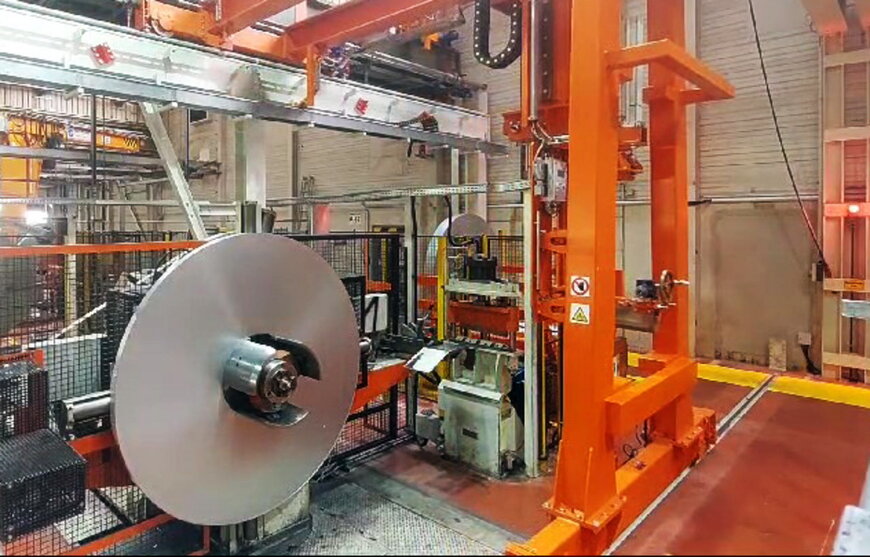
A major European steel and tube manufacturer is deploying two automatic OTO coil loading systems supplied by Fives to optimize production efficiency. The technical solution automates the front-end processing of tube production lines, targeting application areas where large-scale industrial automation interfaces with heavy material handling.
Industrial challenges in coil handling
In traditional tube manufacturing, feeding raw metal coils into a production line presents severe operational bottlenecks and safety hazards. Manual intervention during the initial loading phase exposes operators to heavy, sharp-edged steel strips under high tension. Furthermore, manual positioning introduces process variability, which can lead to misaligned feeding, longer cycle times, and inconsistent tube quality.
To overcome these challenges, the unnamed steel manufacturer partnered with Fives, leveraging the engineering company’s specialized expertise in industrial automation and logistics for the metals sector. The scale and mechanical complexity of managing diverse strip widths required a pre-engineered, automated material handling system capable of seamless integration into an existing production layout.
Automated system architecture and integration
The deployment centers on the OTO automatic coil loading system, which functions as a fully hands-free digital infrastructure component at the entry line. The system utilizes automated, repeatable sequences to transfer steel coils directly into the decoiler mechanism.
Architecturally, the solution integrates with the facility’s overhead crane infrastructure. Sensor arrays and programmable logic controllers (PLCs) coordinate the movement between the crane release and the decoiler engagement. This synchronization ensures precise mechanical alignment along the centerline of the mill, which is critical for maintaining cross-sectional tolerances during subsequent forming and welding stages.
The system is engineered to handle variable production inputs, including narrow-width strips, which typically present tracking difficulties on standard feeding lines. By establishing a fixed, automated sequence, the system standardizes the entry cycle time regardless of the specific coil dimensions or weight.
Operational impacts and process stability
The primary technical objective of the implementation is the reduction of entry line cycle times, directly increasing total manufacturing throughput. By transitioning from manual or semi-automated positioning to a deterministic, machine-controlled sequence, the manufacturer secures high process stability and repeatable positioning precision.
Removing personnel from the immediate loading zone lowers workplace injury risks associated with coil threading and band cutting. Additionally, the continuous, controlled tensioning provided by the automated system reduces physical defects at the leading edge of the strip, protecting downstream tooling and ensuring consistent final tube quality across both carbon and stainless steel applications.
Edited by Evgeny Churilov, Induportals Media - Adapted by AI.
www.fivesgroup.com
