
metalworkingmag.com
15
'26
Written on Modified on
Integrated All In One Automotive Lightweight Bumper System
BENTELER presents the new all in one aluminum bumper system to significantly reduce components and manufacturing steps in modern lightweight vehicle body structures.
www.benteler.com
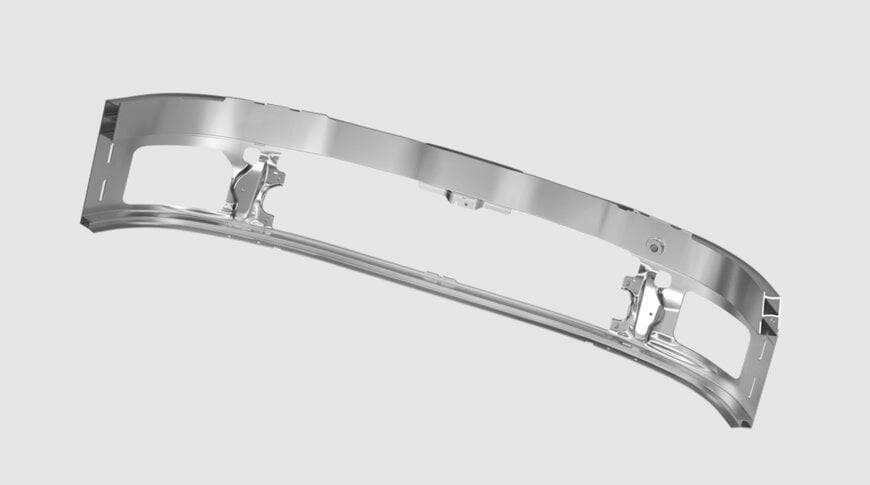
The design of crash-relevant vehicle components increasingly requires solutions that combine the strictest safety specifications with cost efficiency and lightweight construction requirements. To address this industrial demand, BENTELER replaces multi-part crash structures with the highly integrated all-in-one bumper system, which combines upper and lower crossmembers into a single component.
Component Integration and Structural Integrity
Conventional bumper systems often consist of numerous individual parts that must be connected to each other using thermal joining processes such as welding. These joining operations create heat-affected zones, which can weaken the structural integrity of the material and negatively impact crash performance. The all-in-one bumper system solves this problem through a one-piece design. Instead of the previous eleven individual parts, the entire system is formed and cut from a single aluminum extrudate in a special forming line. This process completely eliminates additional assembly steps and thermal joining, thereby avoiding heat-affected zones and significantly increasing the mechanical strength and stability of the bumper system.
Crash Safety and Series Production
By integrating two crossmembers and several functional parts into one structure, not only is the overall weight of the assembly reduced, but energy absorption during an impact is also optimized. In crash tests, particularly in the demanding MPDB (Mobile Progressive Deformable Barrier) frontal impact test for the European and Chinese markets, the new aluminum components achieve the highest values in occupant protection. Stephan Rabl, Development Engineer for Bumper Systems at BENTELER, explains that safety and cost efficiency are the benchmarks of component development and that both goals can be achieved with this system. Series production has been underway since 2024 for two vehicle variants of a German automobile manufacturer in Europe and China. Production takes place on highly automated forming lines. In Europe, in-process scrap is also melted down directly in an in-house casthouse and reused, ensuring a resource-saving supply chain.
Additional Context
This section contains technical specifications and competitive benchmarking that were not included in the original product announcement.
The reduction of individual parts in body manufacturing reflects a broader industrial trend driven by highly advanced aluminum extrusion technologies. Eliminating thermal joining in high-strength aluminum alloys is a critical design approach to maintain the yield strength of the base material across the entire crash structure. Similar highly integrated crash management systems from suppliers on the market also rely on one-piece extrusion profiles to maximize torsional stiffness and reduce assembly costs in large-scale series production. This is particularly relevant for electric vehicles, where battery weight massively increases the need for extremely resilient and simultaneously lightweight structural components in the front and rear areas.
Edited by Maria Brueva, Induportals editor - adapted by AI.
www.benteler.com
