
metalworkingmag.com
21
'26
Written on Modified on
Indexable Copy Milling in Finishing and Semi-Finishing
LMT Tools expands the LMT Kieninger portfolio with the WPR-AP indexable insert for economical finishing processes in die and mold making as well as mechanical engineering.
www.lmt-tools.com
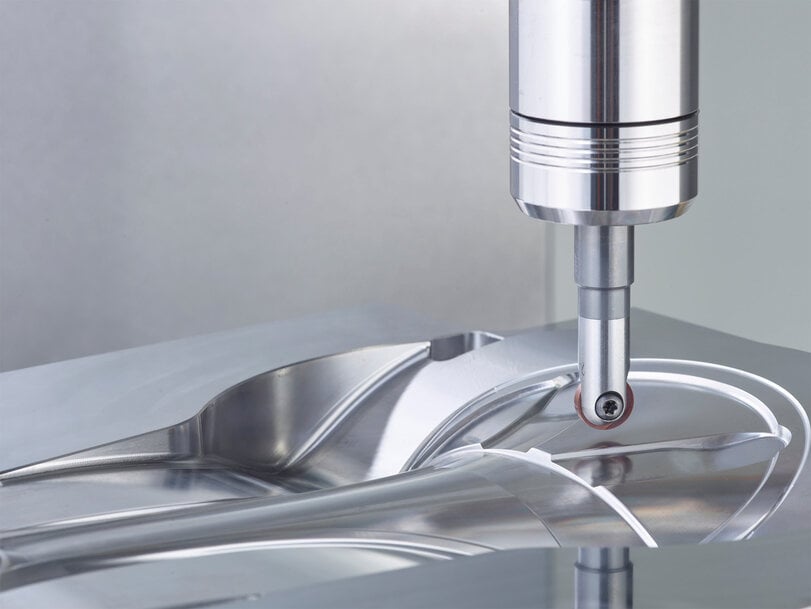
In the demanding machining of complex freeform surfaces, manufacturing companies face the challenge of combining high surface qualities and tight form tolerances with low tooling costs. To substitute expensive solid carbide end mills in finishing and semi-finishing across die and mold making, general mechanical engineering, and energy technology, LMT Kieninger, part of the LMT Tools Group, developed the WPR-AP ball-nose copy milling insert within the CopyLine family.
Process Requirements in Copy Milling of Hardened Materials
Finishing and semi-finishing three-dimensional contours require tools with high radial runout and indexing accuracy, as well as thermal and mechanical wear resistance. Traditionally, solid carbide ball-nose end mills are used for these applications because they offer high rigidity and precision. However, when machining wear-intensive materials—particularly hardened steels or heat-resistant alloys—the complete tool change alongside the complex regrinding and recoating of solid carbide end mills results in high tooling and setup costs.
Modular copy milling systems with indexable inserts reduce the carbide requirement to the actual cutting zone and enable a fast cutting edge change directly inside the machine tool. However, a prerequisite for a reliable substitution of solid carbide tools is a cutting edge geometry and substrate-coating combination that withstands the high cutting pressures and temperatures of hard and fine machining without tool deflection compromising dimensional accuracy.
Cutting Material Architecture and System Integration of the WPR-AP
The WPR-AP ball-nose copy milling insert designed by LMT Kieninger meets these requirements through the interaction of adapted macro and micro geometry, a specific carbide substrate, and a multilayer high-performance coating. The basis is the newly developed LCHK05M cutting material grade, which is engineered for a balanced ratio between fracture toughness and hot hardness. The substrate is complemented by the Nanomold Red³ coating, which increases the thermal barrier effect and minimizes abrasive flank wear at high cutting speeds.
Through this material engineering design, the indexable insert achieves a 30 percent longer tool life compared to previous versions, while simultaneously ensuring the required surface quality on the workpiece. The insert covers the diameter range from 10 mm to 32 mm and is specified for a wide range of materials. In addition to alloyed and unalloyed steels as well as cast steel, this includes heat-resistant materials and hardened steels up to a hardness of 60 HRC.
For mechanical integration into existing production environments, the WPR-AP is designed to be fully backward-compatible with existing holder systems from LMT Kieninger. Manufacturing facilities can deploy the insert on existing screw-in holders, steel holders, or vibration-damping solid carbide holders without new investments in tool holders, adapting the rigidity of the overall system to the respective overhang length and machining task.
Economic Efficiency and Industrial Application Fields
In practice, the tooling system is aimed at near-net-shape semi-finishing and final finishing of cavities, dies, turbine components, and complex mechanical engineering parts. Jens Slaby, Head of Productline Indexable Milling at LMT Tools, outlines the technical positioning: "With the WPR-AP, we offer our customers a high-performance universal solution for finishing and semi-finishing that enables them to increase their productivity and reduce their tooling costs. Wherever precision, process reliability, and cost efficiency are required, the new ball-nose copy milling insert demonstrates its strengths."
By changing the two-flute ball-nose copy insert directly in the holder, the logistics cycles for tool reconditioning typical of solid carbide tools are eliminated, while the tool body can remain permanently in the machine spindle.
Additional Context:
This section details technical specifications and competitive benchmarking not included in the original product announcement.
According to the ISO 513 classification for machining materials, the application range of the WPR-AP extends across the main groups ISO P (steel and cast steel), ISO S (heat-resistant superalloys based on nickel, cobalt, or titanium) up to ISO H (hardened steels up to 60 HRC). Particularly in the ISO H group, extreme alternating loads occur during copy milling due to the interrupted cut and the varying effective cutting speed along the ball contour (from zero at the center to the maximum at the outer diameter). PVD nanolayer coatings such as the applied Nanomold system prevent comb crack formation and delay crater wear in these conditions.
When comparing solid carbide ball-nose end mills and modular indexable ball-nose milling cutters in the diameter range from 10 mm to 32 mm, specific differentiation criteria apply in manufacturing technology:
Solid carbide end mills frequently feature 4 to 8 flutes and achieve a total indicator runout of less than 0.003 mm to 0.005 mm, which enables very high feed per tooth at minimal surface roughness. Above a diameter of 12 mm to 16 mm, however, the material costs for the solid carbide blank increase disproportionately.
Insert-type ball-nose systems with a precision-ground indexable insert feature two effective cutting edges by design. The indexing repeatability in the insert seat of high-precision copy milling cutters typically lies in the range of plus/minus 0.005 mm to 0.010 mm. By eliminating the carbide shank, the cost per cutting edge in the medium diameter range (16 mm to 32 mm) generally decreases by 30 to 50 percent compared to uncoated or reground solid carbide tools.
In the market segment of high-precision ball-nose copy milling cutters with two-flute plug-in inserts, the CopyLine system from LMT Kieninger competes with established tooling systems such as the BallPlus series from Fraisa, the Multi-Master and HeliBall series from Iscar, and the CoroMill 216F systems from Sandvik Coromant. While systems with exchangeable heads (such as Iscar Multi-Master) focus primarily on a high number of flutes in the smaller diameter range from 8 mm to 25 mm, form-fitting clamped plug-in inserts like the WPR-AP from LMT Kieninger specifically address high radial load capacity and axial runout accuracy in deep cavities up to 32 mm in diameter in large tool and mold making.
Edited by Sucithra Mani, Induportals editor – adapted by AI.
www.lmt-tools.com
