
metalworkingmag.com
26
'26
Written on Modified on
Double-Column Five-Axis Milling for Large Parts
Nidec Machine Tool Corporation introduced the MVR-5X five-axis milling machine to resolve rigidity and torque bottlenecks in large workpiece process consolidation.
www.nidec.com
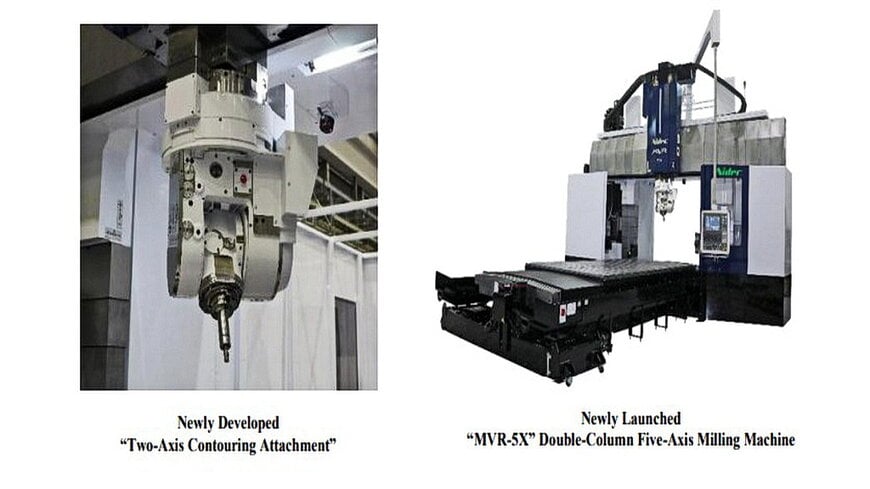
Manufacturing large structural components for semiconductor manufacturing tools, power generation infrastructure, and marine systems requires machining heavy, tough alloys such as alloy steel and cast iron with tight geometric tolerances. Traditional double-column gantry setups often struggle when integrating angular or multi-axis machining, as conventional auxiliary two-axis heads typically suffer from cantilever deflection, low cutting torque, and restricted vertical clearance under the cross-rail. Consequently, machine shops have historically split roughing, deep pocketing, and fine multi-angle finishing across multiple separate setups and distinct machine tools, compounding part setup errors and extending overall cycle times.
Process Consolidation Through High-Torque Contouring
The MVR-5X directly answers these process constraints by pairing a double-column gantry architecture with an integrated, compact two-axis contouring attachment engineered specifically for heavy-duty metal removal. Rather than relying on low-torque auxiliary universal heads limited to light finishing passes, the newly developed milling head delivers a maximum allowable spindle torque of 341 N·m across its BBT50 spindle interface. This represents an increase of 323.5 N·m compared to the manufacturer's previous-generation two-axis attachment, supplying the mechanical force needed to run high-efficiency roughing cuts and face-milling cutters in tough workpiece materials.
The spindle motor provides an output of 15 kW at 420 min⁻¹ with a continuous operating speed range of 20 to 6,000 min⁻¹. Structural redesign of the attachment body reduces its overall projection length from the ram end face to the spindle nose to 790 mm, shaving 300 mm off earlier designs. Shortening this overhang minimizes moment arm leverage and vibration during aggressive cutting passes while recovering vital Z-axis envelope space between the table surface and the cross-rail for tall workpieces.
Continuous Multi-Axis Interpolation and Thermal Management
To handle arbitrary angled surfaces and complex organic contours in a single clamping, the contouring head integrates continuous rotary axis control. The B-axis tilts across a range of ±100°, while the C-axis swivels ±270°, both utilizing 0.001° indexing resolution for precise positioning or simultaneous five-axis contouring. This continuous articulation eliminates secondary manual setups or specialized angled fixturing for complex features such as chamber port angles, complex bevel gearing, and curved mold geometry.
High-precision accuracy over extended machining cycles is maintained by addressing structural thermal growth. The platform utilizes internal spindle core cooling alongside temperature-regulated fluid circulated through Thermo-Stabilizer Columns. This closed-loop thermal mitigation suppresses machine frame distortion caused by ambient shop-floor fluctuations and spindle motor heat dissipation, ensuring repeatable tool positioning during long finishing cycles.
Digital Twin Integration and Production Verification
To mitigate crash risks and prevent programming bottlenecks on capital-intensive machine tools, the machine links with the Nidec NC Twin simulation platform. The software models kinematic machine movements, tooling interference, structural collision boundaries, surface finishes, and cycle times in a virtual environment on a PC. Cycle-time estimations operate with an error margin of less than 1% while processing simulations at speeds up to 20 times faster than physical machining cycles, allowing toolpath optimization before running physical components.
The MVR-5X accommodates table working areas ranging from 1,500 mm × 3,000 mm up to 3,500 mm × 10,000 mm, with distances between columns spanning 2,050 mm to 4,250 mm and maximum ram-to-table clearances between 2,010 mm and 2,150 mm. Primary component applications include vacuum chambers and structural frames for semiconductor equipment, engine cylinder blocks, pump casings, marine propellers, and heavy die and mold cavities.
Nidec Machine Tool presented the MVR-5X to the global manufacturing sector at JIMTOF 2026 (the 33rd Japan International Machine Tool Fair), held October 26–31, 2026, at Tokyo Big Sight in the East Exhibition Halls, Booths E3011–E3013.
Additional Context
This section details technical specifications and competitive benchmarking not included in the original product announcement.
In large-part machining, manufacturers evaluate double-column five-axis configurations against distinct machine kinematics: five-sided portal mills equipped with indexed 90-degree orthogonal heads, five-axis horizontal boring mills (HBMs) featuring rotary tables, and dedicated simultaneous continuous five-axis gantry systems.
While indexed right-angle attachments typically limit positioning to 1-degree, 2.5-degree, or 5-degree Hirth couplings, continuous 0.001° B/C articulation allows true simultaneous contouring along complex fluid dynamic surfaces, such as marine propulsion blades and vacuum chamber transition ports. In contrast to traveling-column horizontal boring machines where deep horizontal quill extension introduces gravity-induced sag and cantilever vibration, a vertical box-way ram operating on a rigid double-column cross-rail maintains structural stiffness across deep cavity roughing.
Thermal mitigation has also emerged as an industry differentiator in large-scale machining platforms governed by ISO 230-3 thermal test standards. Because large cast frames expand several microns per degree Celsius across multi-meter spans, active temperature equalization through fluid-stabilized columns and chilled spindle housings has replaced purely algorithmic software compensation as the benchmark design strategy for precision structural machining.
Edited by Evgeny Churilov, Induportals Media - Adapted by AI.
www.nidec.com
