
metalworkingmag.com
02
'26
Written on Modified on
Advanced Carbide Tooling for High-Temperature Steel Grooving
Horn introduces the IG96 carbide grade to enhance tool life and process stability when machining general and stainless steels under demanding conditions.
www.horn-group.com
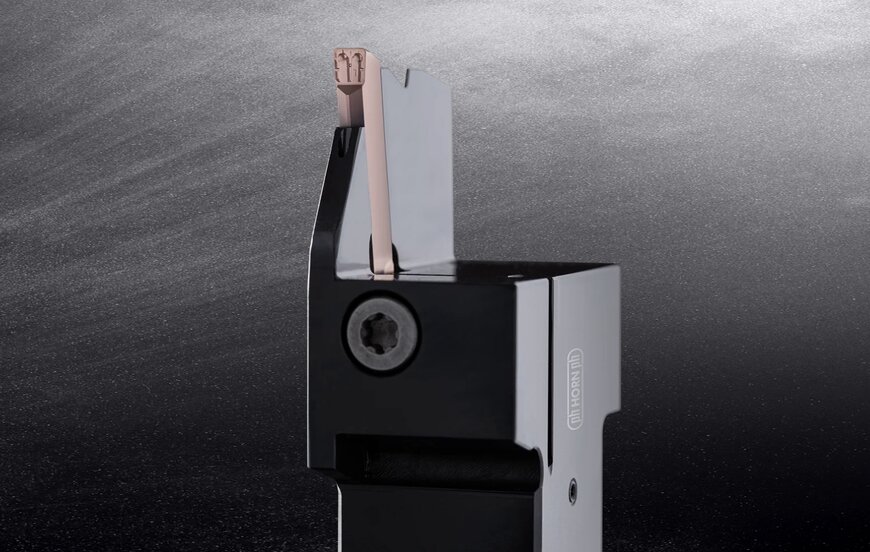
Horn is releasing the IG96 carbide grade, expanding its S224 and S229 grooving systems for industrial metal cutting and precision engineering. This advanced tool coating technology increases high-temperature strength, ensuring stable processing and extended tool life for heavy manufacturing and automotive machining applications.
HiPIMS Coating Technology and Structural Integrity
The IG96 carbide grade incorporates an internally applied coating measuring approximately 9 µm (0.0004 inches) in thickness, manufactured using High-Power Impulse Magnetron Sputtering (HiPIMS) technology. This physical vapor deposition method yields a dense, highly adherent coating structure that significantly increases the thermal deformation resistance of the cutting tool. Available across the L, KF, HR, and KR tool geometries, this coating allows the S224 and S229 grooving systems to maintain process stability when cutting varying grades of general and stainless steels. The in-house application of the HiPIMS coating also supports reduced supply chain lead times for industrial manufacturing facilities.
Measurable Enhancements in Wear Resistance
Field testing indicates measurable improvements in abrasive resistance and component yield across different steel materials. During the machining of C55 steel under identical cutting conditions, an S229.0600.L4 insert utilizing the IG96 grade achieved a tool life of 500 components, representing an increase over the 250 to 280 components produced by previous tool iterations. Similar performance scaling was observed when processing 42CrMo steel, where a custom IG96 insert machined 534 components compared to the 300 components achieved by comparable legacy tools. By mitigating thermal and abrasive degradation, the enhanced wear resistance reduces the required frequency of tool changes, supporting continuous and cost-effective groove turning operations.
Additional Context
This section details technical specifications and competitive benchmarking not included in the original news release.
Within the industrial metal cutting sector, manufacturers such as Sandvik Coromant and Kennametal utilize advanced physical vapor deposition (PVD) and chemical vapor deposition (CVD) coatings to enhance high-temperature performance in steel turning and grooving. When evaluating these tooling systems, benchmark criteria typically focus on coating thickness, thermal deformation resistance, and predictable flank wear. While competitors frequently employ multi-layer chemical vapor deposition coatings measuring between 10 µm and 15 µm for heavy roughing, the 9 µm HiPIMS PVD coating of the IG96 provides an optimized balance specifically for grooving applications. HiPIMS technology generates smoother cutting edges and lower residual tensile stress compared to standard deposition processes, preventing edge micro-chipping during the high-friction cuts often encountered in precision groove turning.
Edited by Aishwarya Mambet, Induportals Editor, with AI assistance.
www.horn-group.com
