
metalworkingmag.com
09
'26
Written on Modified on
Snowbird Technologies demonstrates expeditionary metal 3D printing with Meltio at RIMPAC 2026
The SAMM Tech hybrid manufacturing platform produced mission-critical components aboard the USS Essex, reducing procurement costs by up to 351%.
www.meltio3d.com
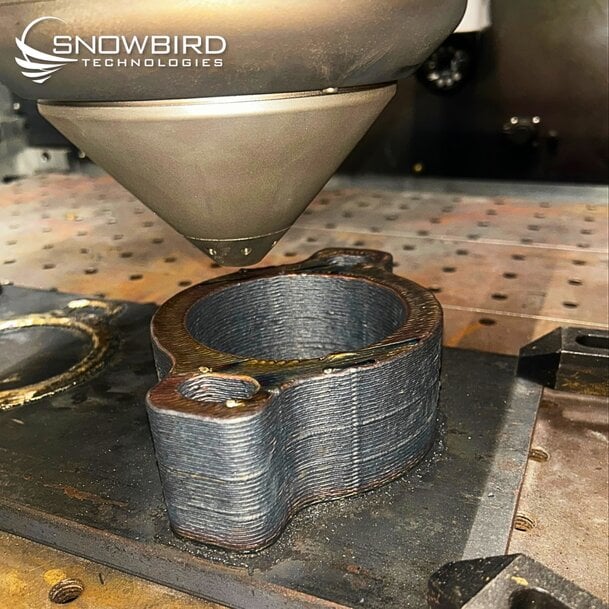
Snowbird Technologies has announced successful operational results from its deployment of the SAMM Tech hybrid manufacturing platform during the RIMPAC 2026 naval exercises. Operating under the Naval Postgraduate School’s Consortium for Advanced Manufacturing Research & Education (CAMRE) and FLEETWERX initiatives, the deployable system successfully executed on-demand metal additive manufacturing both at sea aboard the USS Essex and ashore at Schofield Barracks, Hawaii. Utilizing the Meltio Engine Blue wire-laser deposition system, the platform demonstrated the strategic viability of manufacturing mission-critical replacement parts directly at the point of need, drastically reducing reliance on extended military supply chains.
Measurable economic and lead-time advantages
During the exercise, the SAMM Tech system manufactured seven unique components, including oxygen tank brackets, drain caps, load test clamp components, turnbuckles, a 4-inch pipe flange, and an air pressure radio six-pack. The operational data revealed substantial economic benefits, with four of the seven parts delivering significant cost advantages over traditional OEM procurement. Notably, a Load Test Clamp Outer was printed in just three hours for $101 (wire and gas costs), compared to a $455 procurement cost for delivery to the USS Essex—representing a 351% savings. Similarly, an Air Pressure Radio six-pack yielded a 325% cost reduction. Beyond direct financial savings, the on-demand production capability eliminated approximately 692 hours of procurement lead time on a single order, a critical metric for maintaining mission readiness in contested or austere environments.
Expeditionary sustainment and flexible logistics
A key objective of the RIMPAC deployment was validating the platform's adaptability across diverse operational theaters without depending on conventional facility infrastructure. After completing its shipboard operations, the SAMM Tech system was relocated to Leader’s Field at Schofield Barracks. There, it continued its metal additive manufacturing operations utilizing nitrogen supplied by a localized on-site generator. According to Karl Wojtkun of Snowbird Technologies, this flexibility proves that expeditionary manufacturing is not just about printing parts, but about seamlessly connecting digital files, machining, and inspection capabilities so forward-deployed forces can respond to hardware requirements exactly where and when they arise.
Additional Context: Directed Energy Deposition (DED) and On-Site Nitrogen Shielding
This section details the metallurgical principles of wire-laser additive manufacturing and shielding gas logistics not included in the original press release.
The SAMM Tech platform utilizes a specific branch of additive manufacturing known as Wire-Laser Directed Energy Deposition (W-LMD or DED-W), powered by the Meltio Engine Blue. Unlike ubiquitous Powder Bed Fusion (PBF) systems—which spread fine metal powder across a build plate—W-LMD feeds a continuous solid metal wire directly into a melt pool generated by high-power lasers. This architecture is uniquely suited for maritime environments; loose metal powders are highly combustible, hazardous to breathe, and impossible to manage on a pitching ship deck. Solid wire eliminates these safety and handling risks while achieving near-100% material utilization and significantly higher deposition rates.
Furthermore, the metallurgical integrity of any laser-welded or 3D-printed part depends entirely on protecting the molten metal from atmospheric oxygen and moisture, which cause severe oxidation, slag formation, and internal porosity. In traditional industrial settings, heavy cylinders of Argon (an inert noble gas) are used. However, transporting heavy pressurized gas cylinders is a major logistical bottleneck in expeditionary military operations. By utilizing nitrogen as the shielding process gas, operators can leverage compact on-site Nitrogen Generators—which use Pressure Swing Adsorption (PSA) or hollow-fiber membranes to extract pure nitrogen directly from ambient air. This completely severs the logistical tether to external gas suppliers, allowing the manufacturing platform to operate autonomously indefinitely in austere locations.
Edited by an industrial journalist, Lekshman Ramdas, with AI assistance.
www.meltio3d.com
