
metalworkingmag.com
11
'26
Written on Modified on
Sandvik Coromant Launches Barrel Conical Tool for Complex Profiling Operations
The innovative two-in-one geometry combines barrel and ball-nose radii to boost productivity, improve surface finish, and reduce cycle times on blisk and blade machining.
www.sandvik.coromant.com
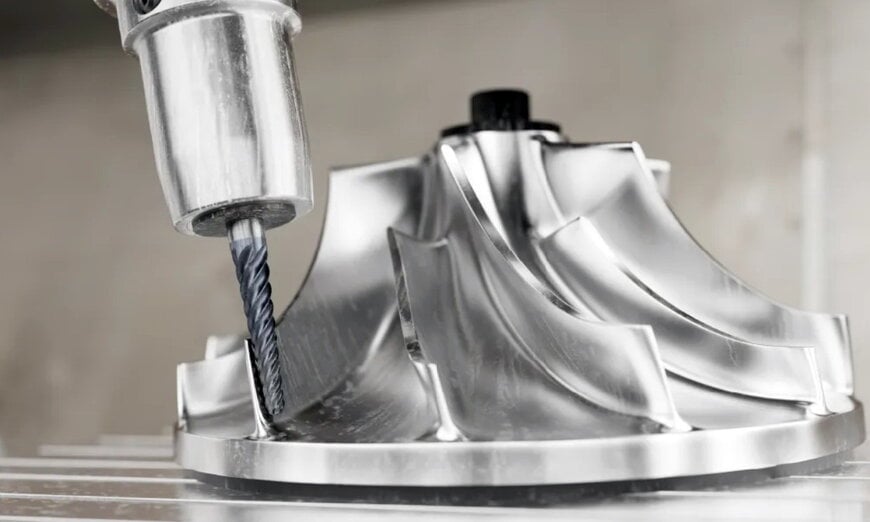
Manufacturing complex 3D profiles in turbomachinery, such as turbine blisks and compressor blades, poses severe challenges for multi-axis milling operations. Machining these freeform surfaces traditionally requires multiple setups and frequent tool switches to navigate varying surface curvatures, leading to prolonged cycle times and accelerated tool wear across difficult-to-cut aerospace alloys.
To address these cycle-time and tool-wear constraints, Sandvik Coromant developed the CoroMill Plura barrel conical end mill. The tool integrates a large tangential barrel profile along its side with a conventional ball-nose radius at the tip, creating a hybrid cutting geometry that supports both flank profiling and point milling within the same operational setup.
Operating Principles and Kinematic Advantages
Multi-axis finishing of curved aero-engine parts has long relied on spherical ball-nose end mills. While versatile, small ball-nose radii mandate minimal step-over increments (cusp height control) to meet rigorous surface-finish criteria, forcing machine tools into thousands of dense tool-path passes.
The conical barrel form alters this kinematic relationship. By deploying an effective cutting radius significantly larger than the physical tool diameter, the barrel section expands the contact arc with the workpiece flank. This allows computer numerical control (CNC) programming systems to increase axial step-over distances substantially without increasing peak-to-valley cusp heights. At the same time, shifting the contact point continuously along the profile curve distributes mechanical loads and thermal spikes across a broader edge length rather than concentrating wear on a localized tip sector. The ball-nose tip remains available to clear tight fillets, transition radii, and complex undercuts without triggering a tool swap.
Substrate and Coating Characteristics for Heat-Resistant Alloys
Turbomachinery blading components are predominantly forged or machined from ISO S materials, including titanium alloys and nickel-, cobalt-, or iron-based heat-resistant superalloys (HRSA). These alloys exhibit high hot strength, low thermal conductivity, and strong strain-hardening tendencies that quickly degrade carbide edges.
The CoroMill Plura barrel conical incorporates dedicated grades T2CH and R2AH, engineered with Zertivo 2.0 physical vapor deposition (PVD) coating technology. Zertivo 2.0 delivers improved coating adhesion and elevated resistance to micro-chipping, notch wear, and thermal cracking under intermittent cut conditions. While engineered primarily for ISO S semi-finishing and finishing, the tool geometries also machine ISO P (steel), ISO M (stainless steel), ISO H (hardened steel), and ISO K (cast iron) components.
Integration in Aerospace Manufacturing Workflows
Within five-axis machining centers, reducing non-cutting indexing and tool-change intervals directly improves spindle utilization. By tackling root fillets, convex flanks, and leading/trailing blade transitions with a singular geometry, process planners can condense previously segregated tool paths into integrated multi-axis profiling programs.
"CoroMill Plura barrel conical gives manufacturers a versatile solution for demanding profiling operations," said Staffan Lundström, Product Manager for solid carbide end milling tools at Sandvik Coromant. "By combining multiple operations in one tool, customers can reduce non-cutting time and achieve a more productive and reliable machining process."
The barrel conical variant complements the wider CoroMill Plura profiling portfolio, which includes dedicated ball-nose, lollipop, conical ball-nose, and standard barrel end mills designed to address point milling, flank milling, and undercut geometries in precision aerospace and power-generation manufacturing.
Additional Context
This section details technical specifications and competitive benchmarking not included in the original product announcement.
Circle segment end mills — often referred to as barrel, lens, or conical circle tools — represent a growing paradigm shift in simultaneous 5-axis computer-aided manufacturing (CAM) strategies. Leading CAM developers, including Mastercam, hyperMILL, and Siemens NX, now provide dedicated barrel-tool path algorithms that maintain constant contact angles and dynamic vector control along complex 3D sweeps.
In aerospace manufacturing, cycle-time reductions achieved through circle-segment milling typically range between 50 percent and 80 percent compared to conventional pure ball-nose finishing passes, purely driven by the increased step-over permissible by large effective radii (often exceeding 250 mm to 1,000 mm on barrel flanks). Within the market for circle-segment tooling, comparable solutions include Emuge-Franken's circle segment end mills (such as their barrel and oval forms) and Seco Tools' solid carbide multi-flute conical barrel mills. While competitive designs similarly exploit large radial profiles to control cusp heights, manufacturing differentiation centers on specific substrate edge toughness, carbide grain sizing, and proprietary PVD multi-layer coatings designed to mitigate abrasive and adhesive wear when running at low cutting speeds in work-hardening HRSA materials.
Edited by Evgeny Churilov, Induportals Media - Adapted by AI.
www.sandvik.coromant.com
