
Powder Bed Fusion 3D Printer for Production Parts
Stratasys H550 SAF system offers a 34.2-litre build volume and 450 mm long axis, with PowderEase T2 automating powder handling for series production.
www.stratasys.com
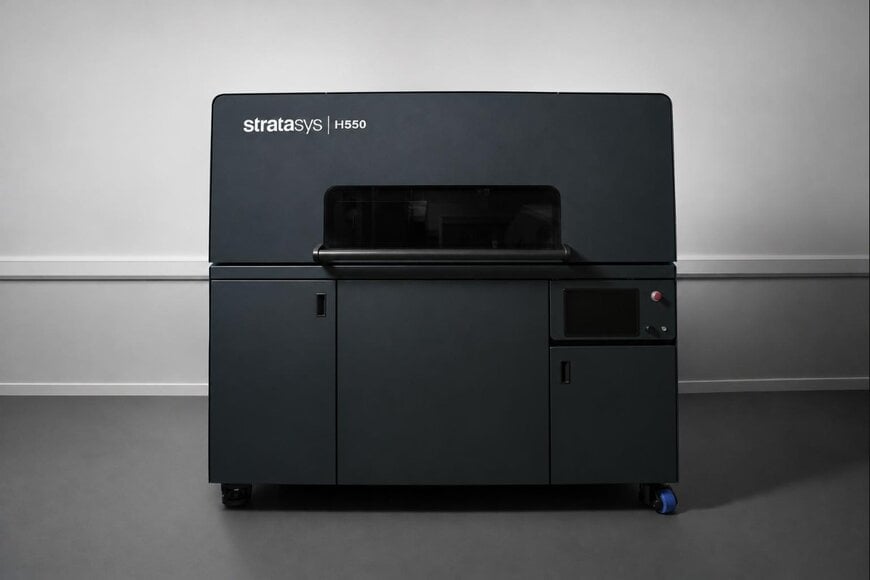
As additive manufacturing moves from prototyping into series production, the economics of polymer powder bed fusion depend on how many parts fit into one build, how large individual parts can be and how much manual work is needed between builds. Stratasys has introduced the H550 industrial 3D printer and the PowderEase T2 post-processing system at Formnext 2026, held from November 17 to 20, 2026, at Messe Frankfurt, Germany.
Target applications include UAV components, robotics and end-of-arm tooling, medical devices, automotive components, and manifolds and ducts, as well as batches of smaller parts.
Build Volume and Part Size in Powder Bed Fusion
The H550 is based on Stratasys' SAF (Selective Absorption Fusion) technology, a print-and-fuse process. It provides a 34.2-litre build volume with a 450 mm long axis. According to Stratasys, this axis is 20% longer than that of the leading comparable print-and-fuse system, which allows longer single parts such as ducts and manifolds to be produced without splitting and joining.
Compared with the existing Stratasys H350, the H550 doubles build capacity. Stratasys states that the system offers up to 30% lower total cost of ownership than comparable print-and-fuse systems and a faster time to part than comparable selective laser sintering (SLS) systems. Reduced infrastructure requirements and a smaller footprint are intended to simplify installation on the factory floor.
Automated Powder Handling With PowderEase T2
In powder bed fusion, post-processing is a major share of labour. PowderEase T2 automates breakout, powder retrieval, sieving and dosing. One station can serve up to six H550 systems running the same material, and the workflow requires less than 30 minutes of total operator time per build. This reduces manual handling of loose powder and allows several printers to be operated with a small team.
Neil Hopkinson, VP SAF at Stratasys and inventor of the technology behind SAF, summarised the positioning: "Longer parts than other print-and-fuse systems, faster than SLS, and at a lower total cost of ownership."
Availability
Pre-orders opened on November 17, 2026, and commercial availability is planned for the second quarter of 2027.
Additional Context:
This section details technical specifications and competitive benchmarking not included in the original product announcement.
In SAF, an industrial inkjet printhead deposits an infrared-absorbing fluid onto each layer of polymer powder, and an infrared lamp then fuses only the areas that have absorbed the fluid. The established print-and-fuse benchmark is HP's Multi Jet Fusion, whose 5200-series systems use a 380 x 284 x 380 mm build unit. Laser-based SLS remains the most widely installed polymer powder bed fusion process. Print-and-fuse systems expose a complete layer at once rather than tracing it with a laser spot, which is why throughput rises with the number of parts packed into a build.
Edited by Evgeny Churilov, Induportals Media - Adapted by AI.
