
metalworkingmag.com
04
'26
Written on Modified on
New HORN tools for precision turning and milling
HORN France will present new tooling geometries for grooving, threading, and PCD milling at SIMODEC 2026, targeting precision machining applications.
www.phorn.de
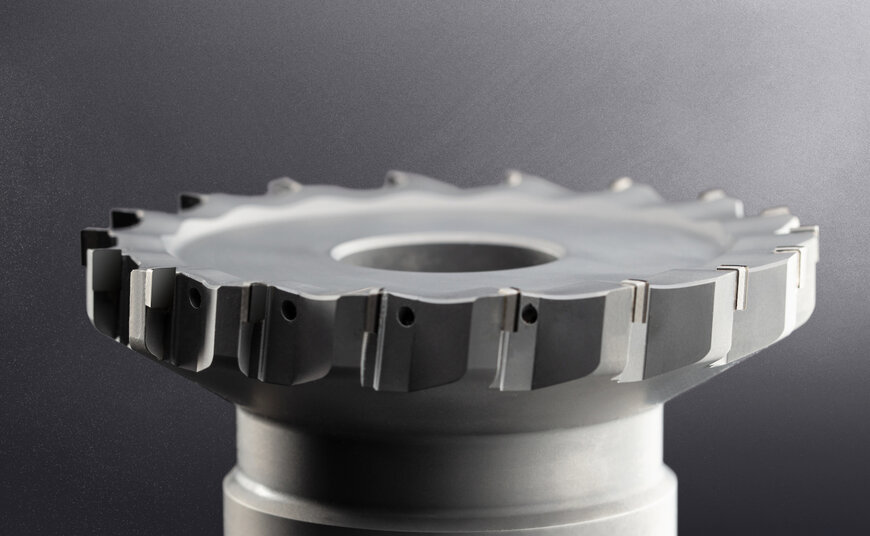
HORN France will exhibit at SIMODEC 2026 (Hall A, Booth E27), the international trade fair for sliding headstock turning and precision machining. The French subsidiary of the German tool manufacturer HORN will present its 2026 product innovations in a French preview, covering grooving, parting, internal threading, and surface milling applications, with a focus on chip control, process stability, and surface quality.
New chipbreaker geometry for grooving and parting
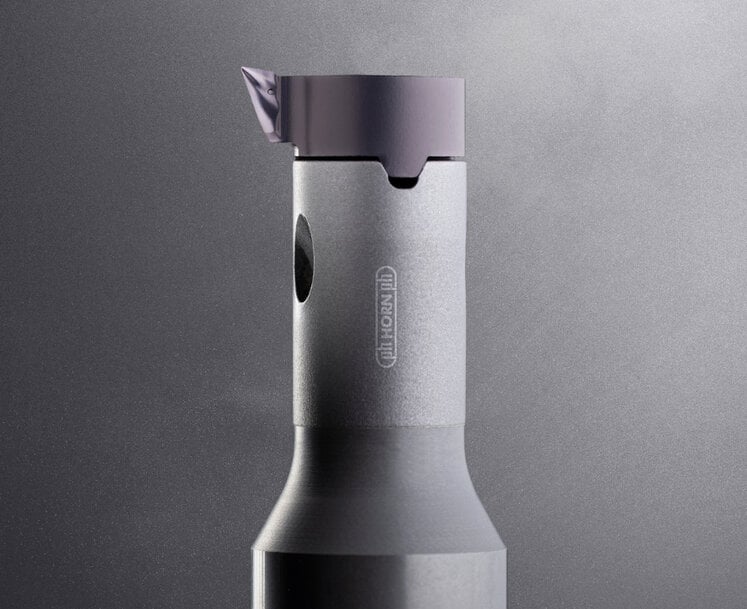
For parting and grooving operations on sliding headstock lathes, HORN introduces a new chipbreaker geometry for the 274 tool system. The sintered 1A chipbreaker geometry is designed to provide controlled chip formation during turning operations, contributing to improved process reliability.
The double-edged insert is available with cutting widths of 1 mm, 1.5 mm, and 2 mm, and supports groove depths between 3 and 6 mm. It is offered in TH35 and IG35 grades for machining a wide range of materials. A broad selection of toolholders enables use on different machine types.
The 274 system achieves indexing repeatability below 0.02 mm when flipping the double-edged insert. This is enabled by precise peripheral grinding of the insert and the rigidity of the insert seat, which is particularly important when machining small-diameter components where tool center height accuracy directly affects part quality.
Expansion of the Supermini system for internal threading
HORN is expanding its Supermini system with a new sintered GM geometry developed for internal ISO metric threading with partial profiles. The geometry promotes the formation of short chips, even when machining difficult, long-chipping materials, reducing the risk of chip accumulation and tool entanglement.
The inserts are suitable for internal metric threads starting from a 5 mm bore diameter, with pitches ranging from 0.5 mm to 1.5 mm. Standard Supermini toolholders are available for direct integration into existing machining setups.
New I geometry for the Mini system
For the Mini tool systems 108, 111, and 114, HORN has developed the sintered I geometry, specifically designed for materials with poor chip-breaking characteristics. It supports profiling, longitudinal turning, back turning, and face turning operations.
The geometry is particularly effective for light cuts in steel and stainless steel, where improved chip control enhances process stability and extends tool life. The development of the I geometry also takes into account the machining of lead-free materials, which are becoming increasingly common in industrial applications.
New PCD milling program: DM70 and DM90 series
As part of its new PCD milling program, HORN introduces the DM70 and DM90 series, developed for face milling and shoulder milling operations, with an emphasis on burr-free machining and high surface quality.
DM70 – High-precision face milling
The DM70 series is designed for face milling in smaller diameter ranges. A precise contact interface between the face and the MDR taper enables face milling accuracies in the micron range. Fast and simple replacement of the PCD-mounted cutter with a carbide toolholder supports streamlined production processes and automated manufacturing environments.
The range includes tools with small and large diameters, as well as short and long HSK63-A toolholders, allowing stable milling operations and access to complex structural components.
DM90 – Burr-free milling for non-ferrous metals
The DM90 series is intended for face milling and shoulder milling applications, including aluminum die-cast components, engine parts, and housings made from non-ferrous metals. It is available in high-edge and low-edge variants, with diameters ranging from 50 mm to 125 mm.
The tools offer axial runout accuracy in the micron range and support roughing cuts up to ap = 4 mm, as well as finishing operations achieving surface finishes below Rz 4 µm, without the need for time-consuming edge presetting.
Technical positioning
With these developments, HORN expands its tooling portfolio for sliding headstock turning and precision machining. The new geometries and PCD milling systems are designed to improve chip control, process stability, and surface quality, addressing increasing demands for productivity and reliability in modern manufacturing environments.
www.horn-group.com
