
metalworkingmag.com
17
'26
Written on Modified on
High-feed milling tool for complex materials
Sandvik Coromant introduces a multi-edge milling concept designed to improve process stability and material removal rates in industrial and aerospace applications.
www.sandvik.coromant.com
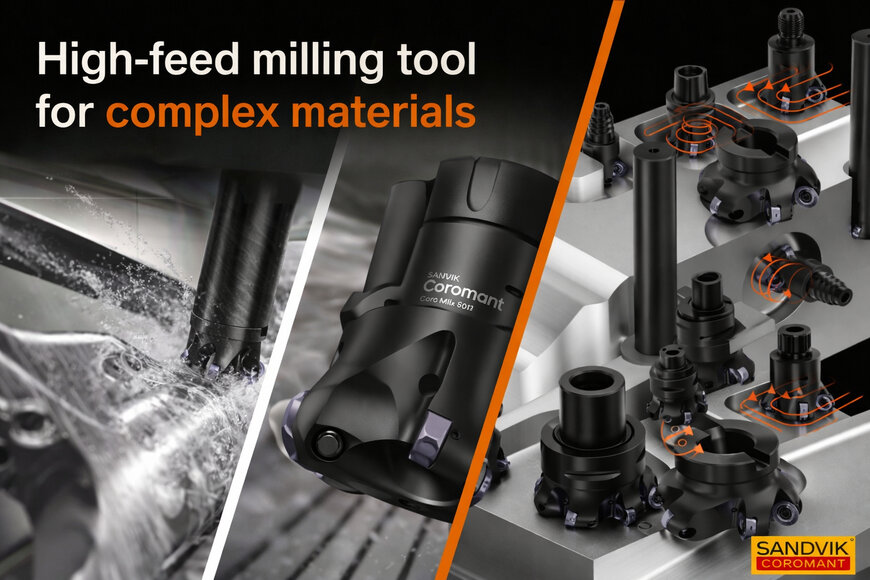
A new multi-edge milling solution has been developed to enhance stability, predictability, and removal volumes in profiling and face milling operations, particularly on difficult-to-machine alloys used in the aerospace and energy sectors.
Process stability in complex machining
Sandvik Coromant has introduced a new milling concept based on single-sided round inserts, designed for high-complexity machining environments. The tool is intended for applications requiring consistent performance in profiling, pocketing, and face milling operations, where stability and process repeatability are critical factors.
The solution is optimized for ISO M materials (stainless steels), ISO S (superalloys and titanium), and ISO P (steels). These categories are typical of industries such as aerospace, oil & gas, and mold and die manufacturing, where process variability can directly affect component quality and cost.
One of the main design goals is reducing variability in machining high-value components. This is particularly relevant in aerospace machining, where materials such as titanium and HRSA (heat-resistant superalloys) exhibit low thermal conductivity and high cutting forces, increasing the risk of tool deflection and unpredictable wear.
Insert and cutter body design
The concept uses round inserts with six cutting edges, allowing multiple indexing positions and extended tool life per insert. The insert body is designed with increased thickness to improve mechanical strength and cutting edge security under high-load conditions.
A key feature is the optimized insert seat interface. The large contact area between insert and cutter body reduces micromovements during machining phenomena often associated with vibration, chipping, and dimensional inaccuracies. Reducing these effects helps maintain tighter tolerances and improved surface consistency.
The cutter body is engineered to resist fatigue and deformation, contributing to longer tool life and consistent performance over extended production cycles.
Integrated cooling and chip evacuation
The tool integrates a coolant system directed beneath the insert, delivering fluid directly into the cutting zone. This improves heat dissipation and chip evacuation, particularly important for long-chipping materials such as stainless steels and superalloys.
Efficient chip evacuation reduces the risk of chip recutting, which can damage both tool and workpiece surface. It also supports the use of higher feed rates while maintaining stable cutting conditions, especially in deep pocketing or complex profiling operations.
Productivity and sustainability
Higher feed per tooth is enabled by the stable geometry and secure insert positioning. This allows increased material removal rates while keeping cutting forces under control, improving overall process efficiency.
From an energy perspective, improved removal efficiency reduces machining time per component and therefore energy consumption per part. Additionally, the longer tool life associated with multi-edge inserts reduces insert consumption and waste generation, contributing to more sustainable manufacturing.
Industrial applications
The solution is intended for roughing and semi-finishing operations across multiple industries. In aerospace, it supports machining of structural components made of titanium and superalloys. In mold and die manufacturing, it is suitable for machining ISO P steels requiring precision and surface quality. In fluid-handling sectors such as pumps and valves, it enables high material removal rates on stainless steel components.
The combination of predictable wear, cutting stability, and efficient chip evacuation meets the requirements of automated and unattended machining, where reliability and operational continuity are essential.
Technological context
Milling cutters with round inserts are widely used for their strength and versatility in multidirectional machining. Compared to conventional inserts, they distribute cutting forces more evenly, improving tool life in difficult materials. The introduction of multi-edge inserts and an optimized seat represents an incremental evolution aimed at enhancing process stability and repeatability.
Edited by an industrial journalist, Sucithra Mani, with AI assistance.
www.sandvik.coromant.com
