
metalworkingmag.com
15
'26
Written on Modified on
Multi-Axis Machining Centers for Integrated Production in Limited Floor Space
Okuma introduces the MULTUS U1000 and U2000 multitasking machines to facilitate 5-axis simultaneous machining and automated workflows within compact manufacturing footprints.
www.okuma.eu
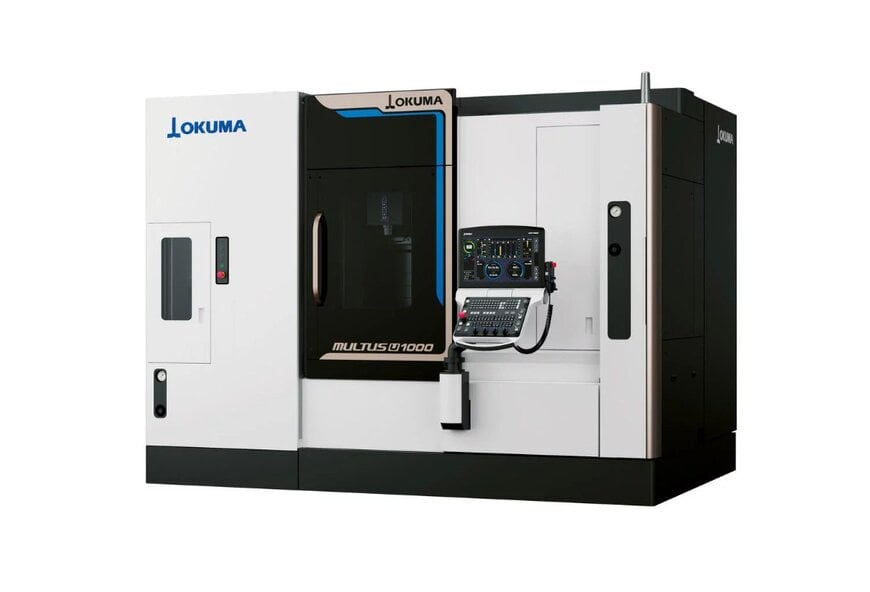
The MULTUS U1000 and MULTUS U2000 are 5-axis multitasking CNC machines designed to consolidate milling and turning operations into a single setup for industries requiring high dimensional accuracy, such as medical technology, robotics, and the electric vehicle sector. By integrating advanced automation interfaces and internal thermal compensation systems, these units address the technical requirements of the modern automotive data ecosystem where precision and uptime are critical for just-in-sequence production.
Technical Specifications and Kinematics
The series utilizes a design focused on high-variety production with minimal manual intervention. The MULTUS U1000 is equipped with a 6-inch chuck and a main spindle capable of speeds up to 6,000 min-1, while the MULTUS U2000 utilizes an 8-inch chuck with a spindle speed of 5,000 min-1. Both models share standardized axis travels of 550 mm (X), 220 mm (Y), and 880 mm (Z). The B-axis provides a 240° range of motion, and the C-axis offers full 360° rotation, enabling the machining of complex geometries and challenging materials like titanium.
To manage high product variety, the machines feature a standard automatic tool changer (ATC) magazine with an 80-tool capacity. For more intensive applications, optional configurations allow for chain magazines of 120 tools or matrix magazines capable of holding 180 tools. This scalability reduces setup times in a digital supply chain where rapid changeovers are essential for maintaining throughput.
Process Integration and Automation
The machine architecture supports several automation layers to increase spindle utilization. Flat machine fronts allow external loading and unloading robots to be positioned in close proximity to the work envelope. Furthermore, an internal loading robot can be integrated directly into the machine structure to minimize the total cell footprint. Material handling is further supported by optional bar feeders for continuous stock supply and dedicated parts unloaders for finished workpiece removal.
Control is managed via the OSP-P500 CNC system, which serves as the interface for both the machining parameters and the integrated safety systems. This includes a Collision Avoidance System that performs real-time simulations of machine movements to prevent mechanical interference during simultaneous 5-axis operations.
Geometric Accuracy and Thermal Stability
Maintaining precision during continuous operation is achieved through a suite of compensation technologies. The 5-Axis Auto Tuning System performs automated calibration to detect and compensate for geometric errors and wear-related tolerances in the machine structure. This is supplemented by the Thermo-Friendly Concept, a design standard that uses symmetrical structures and thermal sensors to stabilize the machine against ambient temperature fluctuations.
For predictive maintenance, an artificial intelligence solution monitors the mechanical condition of the spindles and drive systems, identifying potential failures before they result in unplanned downtime.
Spatial Efficiency and Installation
The MULTUS U1000 and U2000 occupy a physical footprint of 8.2 m², with external dimensions measuring 3,510 mm by 2,345 mm. This narrow profile is specifically engineered for facilities with restricted floor space, allowing for the deployment of multiple units in a serial configuration or the addition of peripheral attachments without exceeding standard industrial bay constraints.
Edited by Evgeny Churilov, Induportals Media - Adapted by AI.
www.okuma.eu
