
metalworkingmag.com
17
'26
Written on Modified on
FEM-Based Bending Simulation and Digital Supply Chain Integration
Lantek introduces a software module update that standardizes data flow across cutting, simulation, and enterprise resource planning systems within manufacturing environments.
www.lantek.com
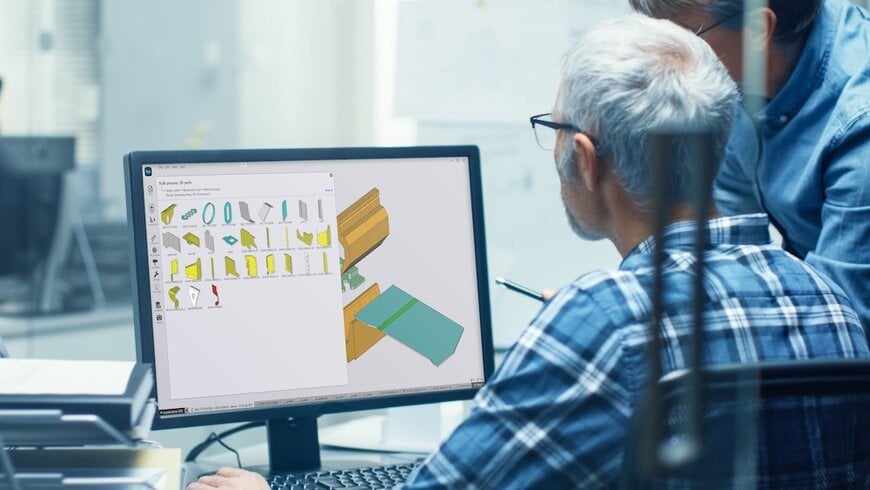
Lantek is releasing the V45 software update to its bending module, integrating 3D component simulation directly into broader manufacturing execution systems. This digital supply chain framework targets sheet metal fabrication facilities utilizing heterogeneous machine parks, standardizing data transfer from initial design to final production.
Resolving Data Fragmentation in Sheet Metal Fabrication
Originally introduced as a standalone application at the EuroBLECH 2022 tradeshow, the bending software was designed to accelerate machine programming operations. The V45 update incorporates the module fully into the broader software ecosystem, expanding interoperability between cutting environments, Manufacturing Execution Systems (MES), and Enterprise Resource Planning (ERP) platforms. By establishing this digital continuity, the architecture reduces the need for manual data transfers between previously fragmented systems.
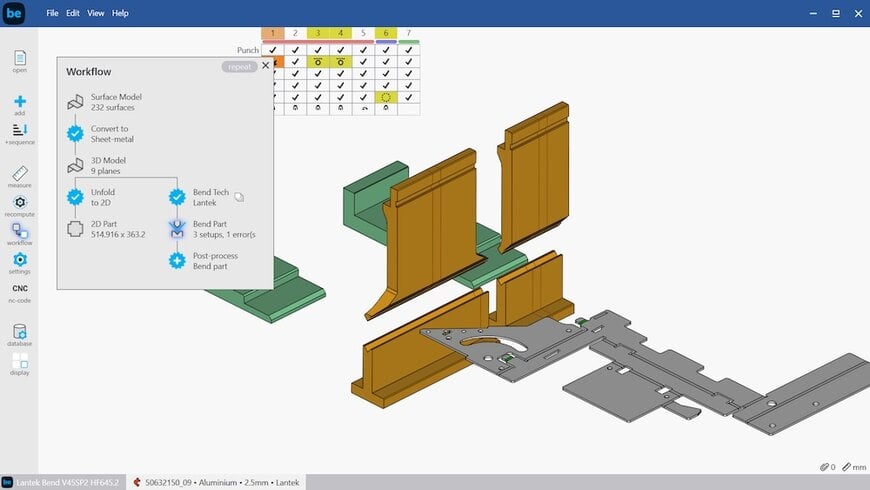
The integration ensures that components designed in 3D can be accurately translated and processed without compatibility losses. Operators can import 3D geometry, which the software either unfolds into a flat pattern for the primary cutting module or opens directly for editing. During this phase, users can simulate the bending process, verify if a design contains flaws, and determine if the geometry data is mathematically suitable for unfolding.
FEM-Based Simulation and Geometric Unfolding Mechanisms
To generate precise bend calculations across different machine brands, the system relies on the Finite Element Method (FEM). This approach calculates deformation accurately by referencing the specific material properties, historical facility data, and available tooling. The calculation engine utilizes a dedicated database containing approximately 8,000 validated tests across specific machine and tool configurations, enabling highly reproducible outcomes.
The software includes an industry-compliant library of more than 7,000 tools, dies, and specialized instruments. The system allows operators to define custom parameters based on specific manufacturing scenarios, such as unique tool shapes, angles, radii, and pull-off requirements. As more scenario data is added, the algorithm automatically adjusts the pull-off diagram, continuously increasing the accuracy of bend predictions.
Production Control and Enterprise System Integration
During operation, the software automatically recognizes all types of bending operations and assigns the correct tooling for simulation. Calculated values and resulting component documentation are automatically generated and stored within the central article database, making them immediately accessible to complementary MES and enterprise integration modules. Furthermore, when an active order is processed in the primary cutting software, the simulated bent part is automatically appended and manufactured synchronously with the parent order.
Christoph Lenhard, Head of the DACH region office, noted that the updated architecture addresses standard causes of production delays, including separate planning systems, heterogeneous machine parks, version conflicts, and incomplete work plans. He indicated that sheet metal manufacturers can map the complex handling of 3D parts and data transfer consistently within a unified software environment, from the initial quotation phase through to completed manufacturing.
Additional Context
This section details technical specifications and competitive benchmarking not included in the original news release.
Independent offline programming (OLP) software for sheet metal bending typically relies on native machine post-processors to translate 3D CAD files into machine-specific bend sequences. While proprietary systems engineered by machine manufacturers offer deep integration strictly for their own hardware, hardware-agnostic platforms are benchmarked primarily on their cross-brand tooling libraries and calculation algorithms.
A standard competitive benchmark is the volume of the digital tooling library. Standard multi-brand OLP systems generally offer between 3,000 and 5,000 standard digital tools out of the box, whereas the Lantek module provides over 7,000, reducing the need for manual tool creation by the operator. Furthermore, entry-level sheet metal calculation engines often utilize standard empirical bend allowance tables (such as static K-factors) to estimate material stretching. In contrast, advanced modules utilize Finite Element Method (FEM) simulations to dynamically model material deformation. This FEM approach yields higher geometric accuracy for complex profiles and high-tensile materials, particularly when deploying files across a heterogeneous mix of bending machines from different original equipment manufacturers.
Edited by Aishwarya Mambet, Induportals Editor, with AI assistance.
www.lantek.com
