
metalworkingmag.com
22
'26
Written on Modified on
Rigid Indexable End Mill Shanks for Multitasking Machine Lathes
Tungaloy Corporation has expanded its TungMeister indexable end mill system with an ER32 size integrated collet shank to improve machining stability.
tungaloy.com
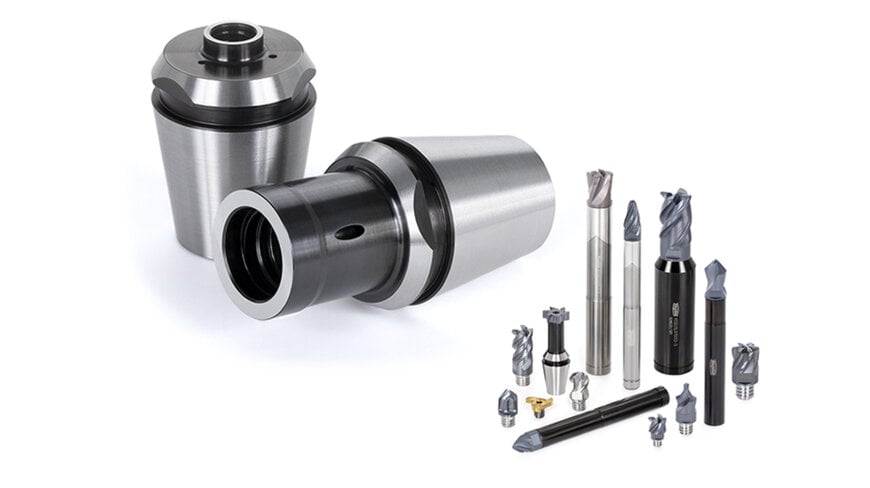
Machining operations in lathes and multitasking machines frequently utilize ER32 collet chucks, where extended tool overhang often introduces chatter, reduces dimensional accuracy, and accelerates tool wear. To address these mechanical limitations, Tungaloy Corporation has expanded its TungMeister head-changeable end mill series by introducing an ER32 size to its integrated ER collet shank lineup. This design merges the ER collet and the shank into a single, continuous steel structure, eliminating the traditional mechanical interface between a separate collet and the tool holder.
By removing this interface, the integrated setup minimizes deflection under radial cutting forces. The design increases overall tool rigidity compared to standard configurations where a separate end mill shank is secured within a conventional elastic collet chuck. This increased stiffness allows manufacturing facilities to deploy indexable end mill systems across a broader range of operating parameters, spanning from high-depth heavy-duty roughing to high-precision finishing cycles.
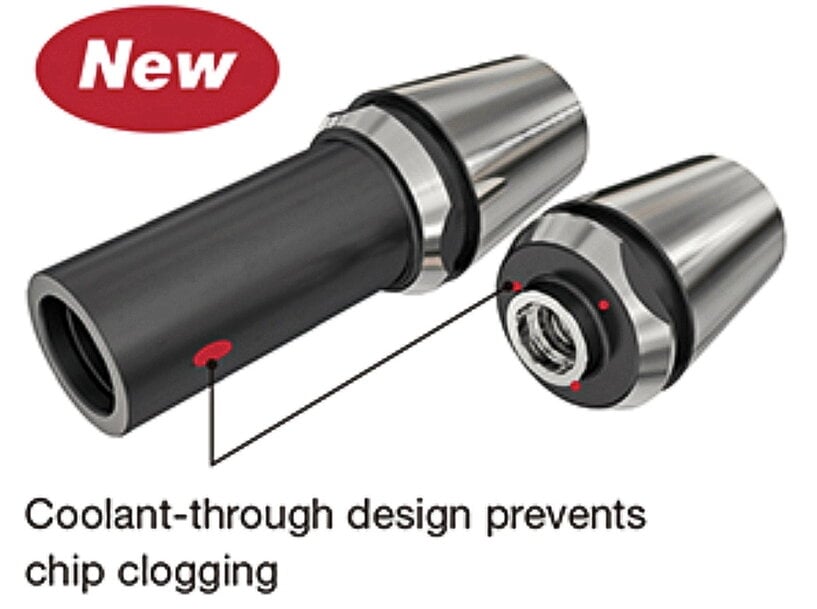
Overhang Optimization and Coolant Delivery Mechanics
The extended tool configurations common in multitasking machine architectures present significant chip evacuation challenges. Insufficient coolant delivery to the cutting zone frequently causes chip entanglement, which leads to thermal shock, micro-chipping of the cutting edges, and unpredictable tool failure.
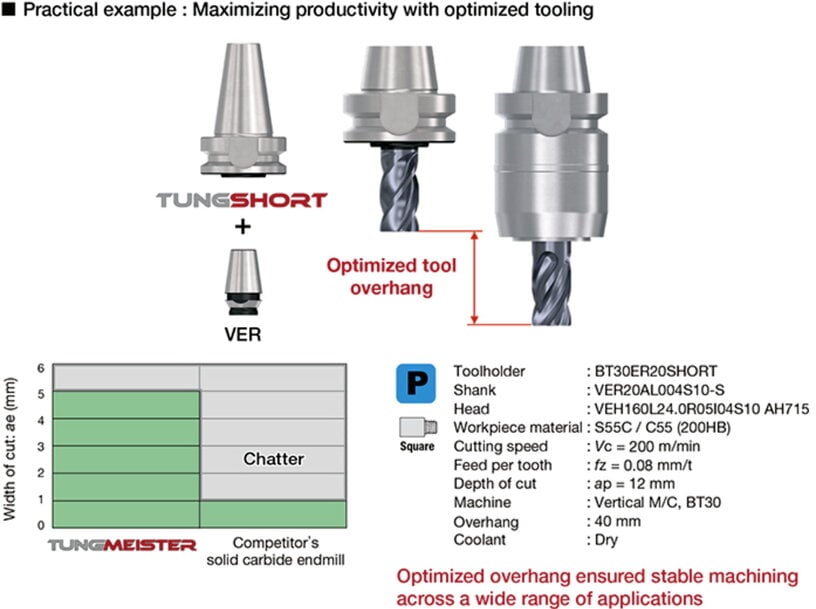
The ER32 integrated collet shanks feature geometric profiles designed with minimized overhang lengths. Shortening the distance from the machine spindle bearing to the cutting edge reduces the bending moment experienced by the tool assembly, which directly suppresses harmonic chatter during continuous machining.
Furthermore, the structural integration allows for optimized internal coolant pathways that deliver cutting fluid directly to the active cutting edges. This localized fluid delivery clears chips from the cutting zone, lowering the risk of chip recutting and catastrophic tool breakage. The resulting reduction in thermal stress improves cutting stability and predictability when processing difficult-to-cut materials, such as stainless steels and aerospace alloys.
Structural Versatility and Application Scope
The modular TungMeister system comprises more than 45 distinct head geometries and multiple carbide grades, covering a diameter spectrum from 5 mm to 32 mm. The modular coupling mechanism relies on a precise thread and tapered face contact system, yielding more than 13,000 viable head-and-shank combinations.
This thread-and-face mating configuration ensures high repeatability during tool changes, allowing operators to replace worn cutting heads directly inside the machine without removing the tool shank from the spindle. This minimizes machine downtime and eliminates the need for external tool presetting between cycles. The addition of the ER32 size complements the existing ER11, ER16, ER20, and ER25 options, standardizing the integrated shank technology across the most common collet capacities used in industrial turning centers.
Additional Context
This section details technical specifications and competitive benchmarking not included in the original product announcement.
Integrated collet shank technology represents a specialized segment within modular rotating tooling systems. While standard ER collet setups adhere to DIN 6499 or ISO 15488 standards — which allow for flexibility across varying shank diameters but introduce cumulative runout errors — integrated systems prioritize concentricity and rigidity. Standard collet assemblies typically exhibit a total indicated runout (TIR) of 5 to 10 microns at 3 times the diameter distance. By consolidating the clamping components into a single piece, integrated ER systems regularly reduce TIR to under 3 microns.
In competitive benchmarking, this configuration competes with ultra-precision collet systems and hydraulic chucks adapted for multitasking machines. While hydraulic chucks offer excellent vibration damping, they possess larger outer diameters that can cause mechanical interference in tight multitasking envelopes. Integrated ER shanks maintain the standard outer dimensions of a conventional ER nut, preserving tool clearance while delivering a structural stiffness that approaches solid-shank holders.
Edited by Evgeny Churilov, Induportals Media - Adapted by AI.
www.tungaloy.com
