
metalworkingmag.com
25
'26
Written on Modified on
Schaeffler Showcases Machine Tool Bearing and Drive Technologies at AMB 2026
Direct-drive torque motors, hybrid spindle bearings, and integrated gear bearings enhance dynamic rigidity and positioning accuracy across automated manufacturing axes.
www.schaeffler.com
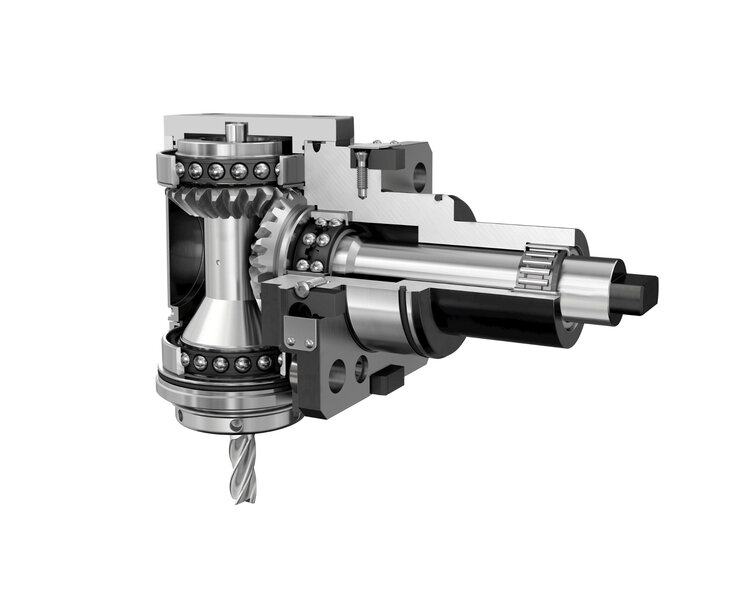
Schaeffler presented a specialized portfolio of mechanical bearings and direct-drive motion assemblies at the metalworking exhibition, AMB 2026 in Stuttgart from September 15 to 19, 2026, in Hall 6, Booth C42. Engineered for modern metal-cutting and automated machine tools, the systems address dynamic force management across workpiece, tool, and linear feed axes.
Exhibition Profile and Industrial Automation Strategy
The product rollout focuses on high-duty operational profiles within automated production lines, where machining centers require extended maintenance intervals and lower energy consumption under sustained mechanical loads.
Ralf Moseberg, Global Sector Lead for Industrial Automation at Schaeffler, noted that machine tool manufacturers require axis solutions that maintain micron-scale accuracy under continuous operating stress while improving the operating life and thermal performance of the parent machine.
Spindle Bearings for Tool Axes and Driven Tooling
Main spindle assemblies integrate the VCM series of hybrid spindle bearings manufactured with ceramic rolling elements and rings composed of powder-metallurgical Vacrodur rolling bearing steel. Vacrodur steel undergoes multi-stage heat treatment to yield a structural hardness of up to 66 HRC alongside thermal stability certified up to 400 degrees Celsius, resisting surface fatigue and rolling contact degradation under marginal lubrication conditions.
For driven tool systems operating as programmable auxiliary axes, Schaeffler introduced PTB precision spindle bearings. Built to ISO precision class P4 standards, the PTB series covers shaft diameters from 10 to 50 millimeters across ISO dimension series 70 and 719, handling high-speed radial and axial cutting forces within constrained tool-holder envelopes.
Rotary Table and Workpiece Axis Integration
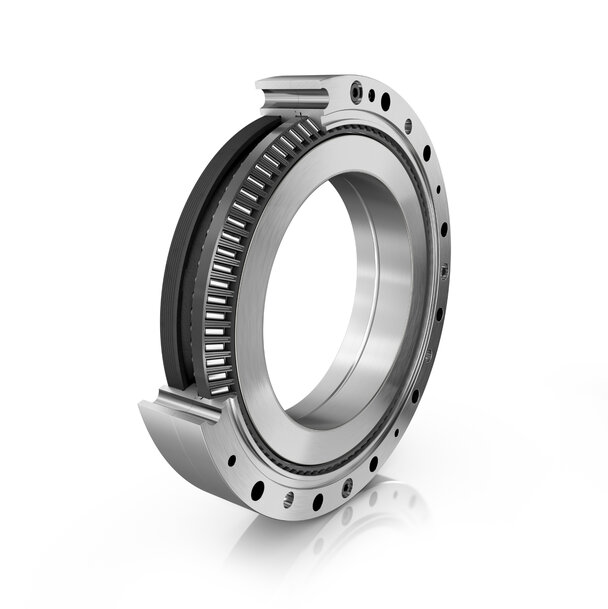
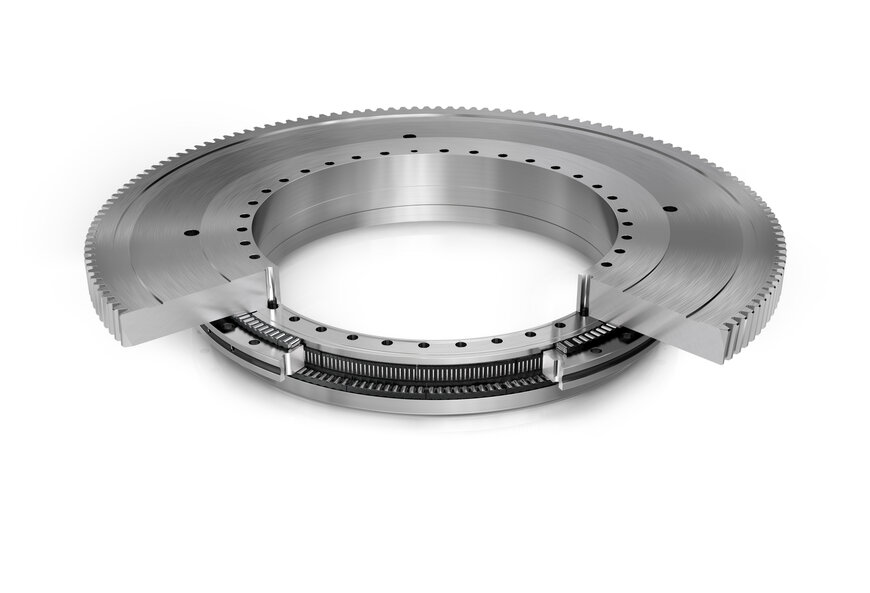
Workpiece positioning is supported by pairing RIB series direct-drive torque motors with YRTC rotary axis bearings. This direct-drive pairing eliminates mechanical worm-gear backlash and maintains dynamic workpiece positioning within micron tolerances solely via closed-loop motor field control, eliminating physical clamping mechanisms and shortening part indexing cycles.
For laser cutting heads and light multi-axis milling, the double-row XZU angular contact needle roller bearing provides high tilting stiffness with a low, uniform frictional torque profile. Outside primary cutting zones, the YRTA axial-radial bearing series supports pallet changers and automated workpiece handling units. To simplify assembly on bridge-type milling heads and rotary tables, the YRTC and YRTA designs are available as YRTCG and YRTAG variants featuring integral gear teeth machined directly onto the shaft washer, replacing external spur or helical gears to reduce installation space and component count.
Linear Feed Axis Guidance and High-Efficiency Linear Motors
For peripheral workpiece transfer and loading units, the four-row KLLT monorail guidance system utilizes an X-arrangement of recirculating ball tracks to absorb geometric mounting misalignments without inducing severe pre-load constraining forces. The modular line offers eight carriage configurations encompassing flanged, unflanged, compact, and high-load formats.
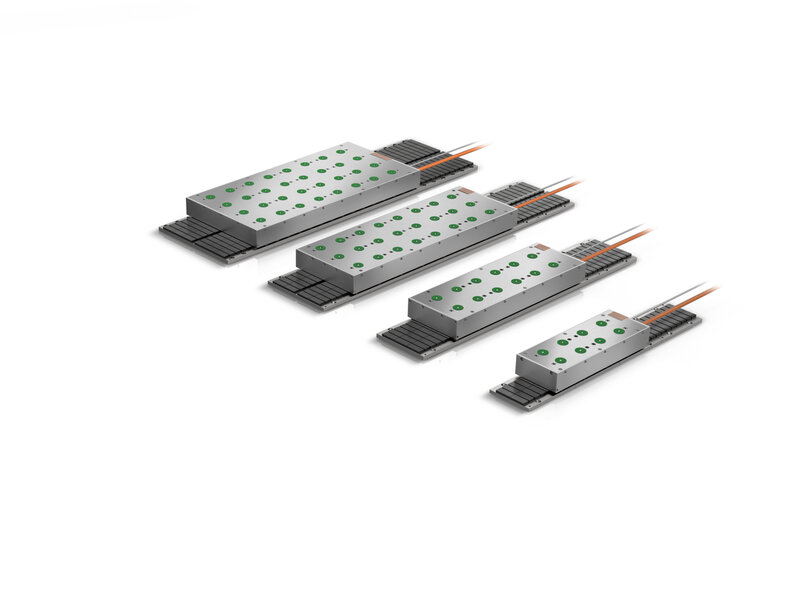
Dynamic linear motion is delivered by L7 linear direct-drive motors. The electromagnetic design reduces power loss by up to 50 percent at equivalent drive thrust or delivers up to 40 percent higher continuous nominal force at equivalent thermal dissipation levels compared to established motor benchmarks, mitigating thermal transfer to adjacent machine structures during rapid acceleration cycles.
Additional Context:
This section details technical specifications and competitive benchmarking not included in the original product announcement
Precision rotary table bearings and direct-drive torque motors are benchmarked on tilting rigidity, axial and radial runout, and thermal loss per unit torque. The primary competitors in this machine tool segment include SKF and THK for rotary axis bearings, and Siemens and ETEL for high-torque linear and direct drives.
In rotary table applications, Schaeffler YRTC cylindrical roller axial-radial bearings compete directly with the SKF NRT series. While SKF NRT bearings utilize axial roller and cage assemblies with radial needle rollers to support multi-directional loads with radial runouts under 3 micrometers, the YRTC series employs dual axial roller tracks with an integrated radial roller cage that yields up to 30 percent higher tilting stiffness in comparable metric boundary dimensions. Furthermore, the integration of precision gearing directly into the bearing shaft washer (YRTCG) eliminates the radial runout tolerance stack-up inherent when bolting independent gear rings to SKF NRT or standard crossed-roller arrangements.
For high-speed spindle axes, standard high-precision spindle bearings from NSK and SKF utilize through-hardened 100Cr6 bearing steel, which exhibits structural softening and accelerated adhesive wear when operating contact temperatures exceed 150 to 180 degrees Celsius during lubrication starvation. In contrast, powder-metallurgical Vacrodur steel maintains 65 to 66 HRC hardness up to 400 degrees Celsius, delivering more than twenty times the rating life of standard 100Cr6 steel under certified mixed-friction operating conditions.
In the direct-drive linear domain, the Schaeffler L7 linear motor competes with Siemens 1FN3 and ETEL LMS series iron-core synchronous motors. While conventional iron-core linear drives achieve continuous force densities between 2 and 4 Newtons per square centimeter of primary surface area, their internal resistive copper losses generate substantial heat that requires external closed-loop chiller circuits. The L7 motor design reduces internal electrical resistance and optimizes slot-fill density, allowing higher continuous acceleration profiles while cutting motor thermal dissipation into the machine tool bed by half under identical duty cycles.
Edited by Natania Lyngdoh, Induportals editor, assisted by AI.
www.schaeffler.com
