
metalworkingmag.com
09
'26
Written on Modified on
Liquid Cooling Connector Machining for AI Data Centers
Advanced tooling solutions, including TetraMiniCut and TFX, optimize the precision machining of stainless-steel liquid cooling connectors for high-density AI data center infrastructure.
tungaloy.com

The transition toward direct liquid cooling in high-performance computing and artificial intelligence infrastructure requires the large-scale production of precision cold plates, manifolds, and coolant distribution units. Manufacturers are deploying specialized machining solutions to produce the reliable quick disconnect couplings needed to move coolant safely through these advanced thermal management systems.
Functional Requirements and Material Challenges
Quick disconnect couplings, such as UQD, MQD, and blind-mate designs, allow different sections of a liquid cooling circuit to be connected and disconnected during server installation and maintenance. The operational reliability of these compact components depends on accurate mating surfaces, internal geometries, and grooves to ensure secure sealing and consistent coolant flow. These connectors are predominantly manufactured from corrosion-resistant stainless steels, including AISI 303, 304, and 316. Processing these specific alloys presents significant manufacturing challenges, including excessive heat generation, work hardening, built-up edge, and difficult chip control during automated Swiss-type production.
Tooling Solutions for High-Volume Production
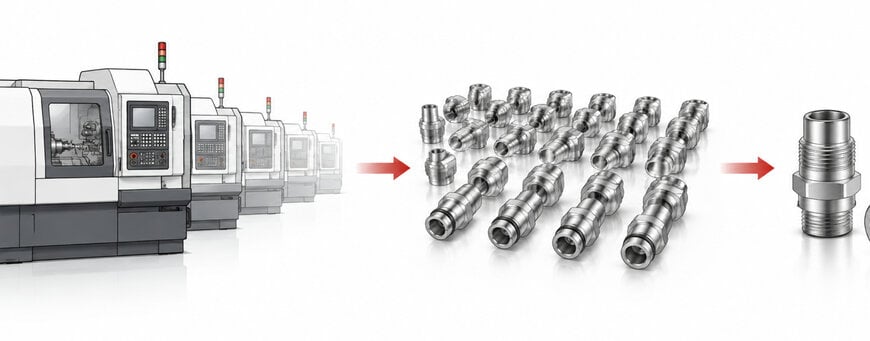
Producing these components efficiently at a production scale requires specialized tooling to maintain dimensional accuracy and surface quality across multiple operations, such as turning, drilling, and threading. For the UQD plug body, the TFX (The Front Max) system enables deeper depths of cut during external turning, which reduces the required number of passes and shortens the overall cycle time. In the production of the compact MQD socket body, the TetraMiniCut tool provides stable face grooving at the connection interface, utilizing a multi-corner insert design to optimize tooling costs for volume manufacturing.
Chip Evacuation and Process Stability
The machining of complex geometries, such as the distinctive three-lobe profile of the MQDB socket valve, creates specific chip-control issues. In these applications, chips can become trapped around the workpiece and disrupt process stability, directly affecting the finished surfaces. The implementation of the TMV chipbreaker directs metal chips toward the chuck side, promoting reliable evacuation and preventing machining failures. This combination of targeted tooling and stainless-steel machining strategies ensures the precision and reliability demanded by modern liquid cooling networks in high-density computing environments.
Edited by Maria Brueva, Induportals editor – adapted by AI.
www.tungaloy.com
