
metalworkingmag.com
20
'26
Written on Modified on
AI-Native Machining: From CNC Automation to Intelligent Manufacturing
How real-time optimisation, generative CAM and autonomous quality control are transforming the machining process.
induportals-media-publishing.com
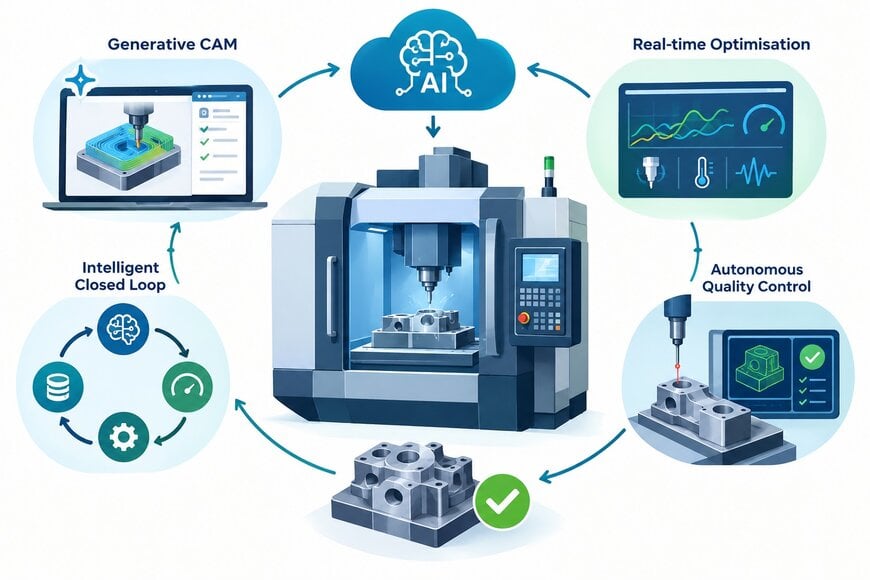
AI-enhanced machining creates an intelligent closed-loop system. AI generated image
Traditional CNC machining has revolutionised manufacturing by automating the movement of cutting tools along programmed paths. Yet, despite its precision and repeatability, conventional CNC machining largely follows predetermined instructions. If cutting conditions change, a tool begins to wear, or vibration threatens surface quality, the machine generally needs predefined corrective logic or human intervention to respond.
AI-native machining represents the next step: a manufacturing system that can sense, learn, decide and adapt while machining is in progress. Rather than simply executing a programme, it uses artificial intelligence (AI), machine data, simulation and feedback from inspection systems to optimise the process continuously.
From programmed automation to a closed loop
In conventional CNC machining, an engineer develops a toolpath, selects cutting parameters and loads the programme into the controller. The machine executes these instructions, while operators monitor performance and inspect finished components.
AI-enhanced machining introduces another layer. Sensors and controller data can reveal changes in spindle load, vibration, temperature, cutting forces and tool condition. AI models interpret these signals to identify deviations, predict emerging problems and recommend or initiate corrective action.
The result is an intelligent closed-loop system. Data from the machining process informs decisions, adjustments influence subsequent cutting operations, and fresh measurements establish whether those adjustments have worked.
Real-time optimisation: Making every cut count
One of the most immediate benefits of AI-native machining is the ability to optimise cutting conditions dynamically. Conventional programmes use specified feeds and speeds, whereas intelligent systems can respond to changing cutting loads, material variations and emerging vibration.
For example, if a tool encounters greater resistance than anticipated, an optimisation system can adjust feed rates within validated limits. If it detects abnormal cutting behaviour or potential tool breakage, it can intervene before the problem produces scrap or damages equipment.
This is particularly valuable in aerospace, automotive and precision engineering, where expensive materials, demanding tolerances and long machining cycles make every improvement significant.
Siemens' Advanced CNC Machining (ACM) Suite illustrates this approach through machine-learning-based monitoring, adaptive feed-rate optimisation and anomaly detection. Its tools are designed to improve productivity while working with existing machining processes and NC programmes.
Generative CAM: Bridging the skills gap
Programming remains a major bottleneck in machining. Creating efficient toolpaths requires knowledge of part geometry, tooling, materials, machine capabilities and cutting strategies. Experienced CAM (Computer-Aided Manufacturing) programmers are not always readily available, particularly in small and medium-sized manufacturing enterprises.
AI-assisted and generative CAM technologies aim to reduce this dependency. They can recognise features in a CAD model, recommend machining sequences, select appropriate strategies and automate portions of toolpath generation. AI copilots can also provide contextual guidance through natural-language interaction.
The distinction is that generative CAM does more than reproduce an existing programme: it helps develop machining strategies from the part requirements and available manufacturing knowledge. The output must still be checked for machine compatibility, collisions, tooling constraints and safe cutting conditions.
CloudNC's CAM Assist is an example. It automates significant portions of CNC programming within supported CAM environments, helping programmers generate machining strategies faster while retaining the ability to review and refine the results. This makes advanced programming capabilities more accessible to less-experienced users.
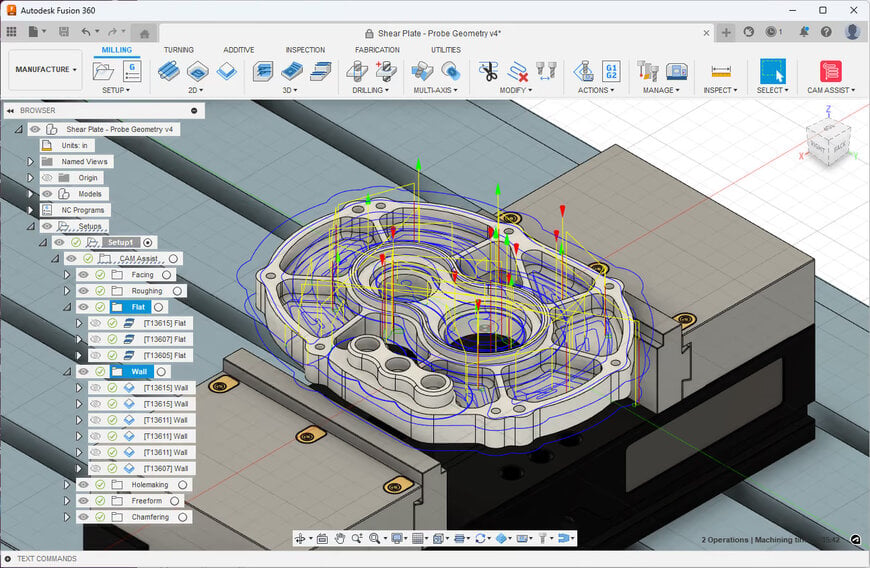
CloudNC's CAM Assist is available on Autodesk App Store. Photo credit: CloudNC
Autonomous quality control: Inspection becomes part of machining
In conventional production, quality control often follows machining: components are removed, measured and either accepted or sent for rework. AI-native machining moves inspection closer to the process itself.
On-machine probes can measure critical features during or between operations, while machine data and inspection results help identify deviations. Where the system supports closed-loop correction, it can update work offsets, compensate for tool wear or adjust subsequent operations. Machine vision and external metrology systems can provide additional verification where appropriate.
Sandvik's Mastercam Copilot is an example, which brings AI-assisted guidance into CAM programming. Using conversational assistance, it helps machinists navigate programming tasks and access relevant expertise. Together with Sandvik's wider manufacturing software ecosystem, this represents another route towards reducing the knowledge gap and connecting programming with intelligent manufacturing workflows.
The road to intelligent machining
AI-native machining is not a single product or a feature that can simply be switched on. It is an evolving architecture connecting digital programming, machine monitoring, optimisation, inspection and corrective action.
The three examples illustrate complementary approaches: Siemens addresses process optimisation and integrated inspection; CloudNC reduces the programming burden through automated CAM; and Sandvik brings AI assistance into established CAM workflows.
The next challenge is to connect these capabilities into a reliable, secure and traceable production system. Human oversight will remain essential for validating programmes, approving process limits and managing exceptional conditions.
Edited by Milton DSilva, a Freelance Contributor, with AI assistance.
www.metalworkingmag.com
Traditional CNC machining has revolutionised manufacturing by automating the movement of cutting tools along programmed paths. Yet, despite its precision and repeatability, conventional CNC machining largely follows predetermined instructions. If cutting conditions change, a tool begins to wear, or vibration threatens surface quality, the machine generally needs predefined corrective logic or human intervention to respond.
AI-native machining represents the next step: a manufacturing system that can sense, learn, decide and adapt while machining is in progress. Rather than simply executing a programme, it uses artificial intelligence (AI), machine data, simulation and feedback from inspection systems to optimise the process continuously.
From programmed automation to a closed loop
In conventional CNC machining, an engineer develops a toolpath, selects cutting parameters and loads the programme into the controller. The machine executes these instructions, while operators monitor performance and inspect finished components.
AI-enhanced machining introduces another layer. Sensors and controller data can reveal changes in spindle load, vibration, temperature, cutting forces and tool condition. AI models interpret these signals to identify deviations, predict emerging problems and recommend or initiate corrective action.
The result is an intelligent closed-loop system. Data from the machining process informs decisions, adjustments influence subsequent cutting operations, and fresh measurements establish whether those adjustments have worked.
Real-time optimisation: Making every cut count
One of the most immediate benefits of AI-native machining is the ability to optimise cutting conditions dynamically. Conventional programmes use specified feeds and speeds, whereas intelligent systems can respond to changing cutting loads, material variations and emerging vibration.
For example, if a tool encounters greater resistance than anticipated, an optimisation system can adjust feed rates within validated limits. If it detects abnormal cutting behaviour or potential tool breakage, it can intervene before the problem produces scrap or damages equipment.
This is particularly valuable in aerospace, automotive and precision engineering, where expensive materials, demanding tolerances and long machining cycles make every improvement significant.
Siemens' Advanced CNC Machining (ACM) Suite illustrates this approach through machine-learning-based monitoring, adaptive feed-rate optimisation and anomaly detection. Its tools are designed to improve productivity while working with existing machining processes and NC programmes.
Generative CAM: Bridging the skills gap
Programming remains a major bottleneck in machining. Creating efficient toolpaths requires knowledge of part geometry, tooling, materials, machine capabilities and cutting strategies. Experienced CAM (Computer-Aided Manufacturing) programmers are not always readily available, particularly in small and medium-sized manufacturing enterprises.
AI-assisted and generative CAM technologies aim to reduce this dependency. They can recognise features in a CAD model, recommend machining sequences, select appropriate strategies and automate portions of toolpath generation. AI copilots can also provide contextual guidance through natural-language interaction.
The distinction is that generative CAM does more than reproduce an existing programme: it helps develop machining strategies from the part requirements and available manufacturing knowledge. The output must still be checked for machine compatibility, collisions, tooling constraints and safe cutting conditions.
CloudNC's CAM Assist is an example. It automates significant portions of CNC programming within supported CAM environments, helping programmers generate machining strategies faster while retaining the ability to review and refine the results. This makes advanced programming capabilities more accessible to less-experienced users.
CloudNC's CAM Assist is available on Autodesk App Store. Photo credit: CloudNC
Autonomous quality control: Inspection becomes part of machining
In conventional production, quality control often follows machining: components are removed, measured and either accepted or sent for rework. AI-native machining moves inspection closer to the process itself.
On-machine probes can measure critical features during or between operations, while machine data and inspection results help identify deviations. Where the system supports closed-loop correction, it can update work offsets, compensate for tool wear or adjust subsequent operations. Machine vision and external metrology systems can provide additional verification where appropriate.
Sandvik's Mastercam Copilot is an example, which brings AI-assisted guidance into CAM programming. Using conversational assistance, it helps machinists navigate programming tasks and access relevant expertise. Together with Sandvik's wider manufacturing software ecosystem, this represents another route towards reducing the knowledge gap and connecting programming with intelligent manufacturing workflows.
The road to intelligent machining
AI-native machining is not a single product or a feature that can simply be switched on. It is an evolving architecture connecting digital programming, machine monitoring, optimisation, inspection and corrective action.
The three examples illustrate complementary approaches: Siemens addresses process optimisation and integrated inspection; CloudNC reduces the programming burden through automated CAM; and Sandvik brings AI assistance into established CAM workflows.
The next challenge is to connect these capabilities into a reliable, secure and traceable production system. Human oversight will remain essential for validating programmes, approving process limits and managing exceptional conditions.
Edited by Milton DSilva, a Freelance Contributor, with AI assistance.
www.metalworkingmag.com
