
metalworkingmag.com
19
'26
Written on Modified on
Desktop Micro-Precision 3D Printing Systems for Industrial Prototyping
BMF introduced compact micro-scale additive manufacturing systems designed to support faster prototyping and controlled fabrication of small functional components.
bmf3d.com
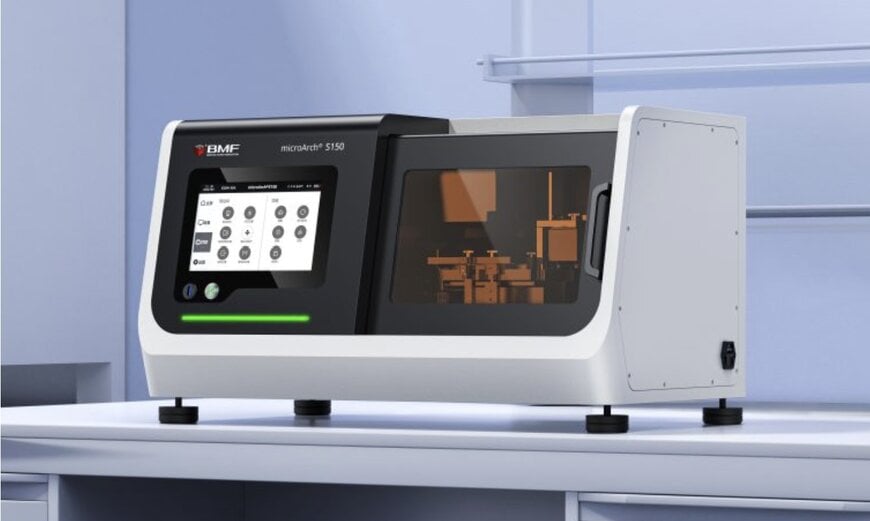
Micro-scale additive manufacturing is increasingly used in sectors such as biomedical engineering, microfluidics, photonics, and electronics, where component geometries often fall below the limits of conventional fabrication methods. In this context, Boston Micro Fabrication introduced the microArch® S150 Series, a compact set of micro-precision 3D printers designed for laboratory development, prototyping, and small-batch production.
The series includes two systems: the microArch® S150 Ultra, intended for higher-throughput workflows, and the microArch® S150, positioned for research environments and precision prototyping.
Throughput and dimensional control in micro-scale fabrication
The microArch® S150 Ultra is specified to deliver print speeds up to nine times higher than the standard microArch® S150, supporting faster iteration cycles in design validation and small-volume manufacturing. Typical target components include microneedles, microchannels, precision nozzles, and miniature electronic structures.
Both systems are based on Boston Micro Fabrication’s Projection Micro Stereolithography (PµSL) technology, which uses projected light patterns to polymerize photopolymers with fine spatial control. The systems provide:
- Optical resolution of 25 µm
- Positional accuracy of ±3 µm
- Layer thicknesses between 10 µm and 100 µm
These parameters place the systems within the range required for functional testing of micro-mechanical parts, fluidic channels, and optical components where dimensional tolerances directly affect performance.
Application areas include microfluidic device fabrication, fiber-optic component prototyping, biomedical device development, electronics packaging research, and academic materials research.
Automation features targeting workflow stability
The systems incorporate automation features intended to reduce setup complexity typically associated with micro-precision additive manufacturing. A fully automated setup process removes manual calibration steps, while preconfigured print parameters aim to improve process repeatability.
An integrated touchscreen interface supports one-touch operation for routine printing tasks. The systems also support high-viscosity materials, enabling the use of a broader range of photopolymer formulations.
Environmental control features include a HEPA13 filtration system and an integrated UV-C sterilization module operating at 253.7 nm, designed to maintain build-chamber cleanliness. These features support use cases involving contamination-sensitive components, including biomedical prototypes and microfluidic devices.
Positioning micro-precision printing as a desktop engineering tool
By reducing equipment footprint and simplifying operation, the microArch® S150 Series targets engineering teams seeking to integrate micro-scale additive manufacturing directly into development workflows rather than relying on centralized fabrication resources.
The approach reflects a broader trend toward decentralised additive manufacturing and digital prototyping workflows, where design teams increasingly require direct access to fabrication tools to shorten development cycles.
Edited by industrial journalist, Aishwarya Mambet, with AI-assistance.
www.bmf3d.com
Application areas include microfluidic device fabrication, fiber-optic component prototyping, biomedical device development, electronics packaging research, and academic materials research.
Automation features targeting workflow stability
The systems incorporate automation features intended to reduce setup complexity typically associated with micro-precision additive manufacturing. A fully automated setup process removes manual calibration steps, while preconfigured print parameters aim to improve process repeatability.
An integrated touchscreen interface supports one-touch operation for routine printing tasks. The systems also support high-viscosity materials, enabling the use of a broader range of photopolymer formulations.
Environmental control features include a HEPA13 filtration system and an integrated UV-C sterilization module operating at 253.7 nm, designed to maintain build-chamber cleanliness. These features support use cases involving contamination-sensitive components, including biomedical prototypes and microfluidic devices.
Positioning micro-precision printing as a desktop engineering tool
By reducing equipment footprint and simplifying operation, the microArch® S150 Series targets engineering teams seeking to integrate micro-scale additive manufacturing directly into development workflows rather than relying on centralized fabrication resources.
The approach reflects a broader trend toward decentralised additive manufacturing and digital prototyping workflows, where design teams increasingly require direct access to fabrication tools to shorten development cycles.
Edited by industrial journalist, Aishwarya Mambet, with AI-assistance.
www.bmf3d.com
