
metalworkingmag.com
11
'26
Written on Modified on
Metal Additive Manufacturing Support Reduction Through Dynamic Thermal Control
Renishaw introduces LIBERTAS technology to control laser energy distribution, mitigating thermal stresses and eliminating support structures in metal printing.
www.renishaw.com
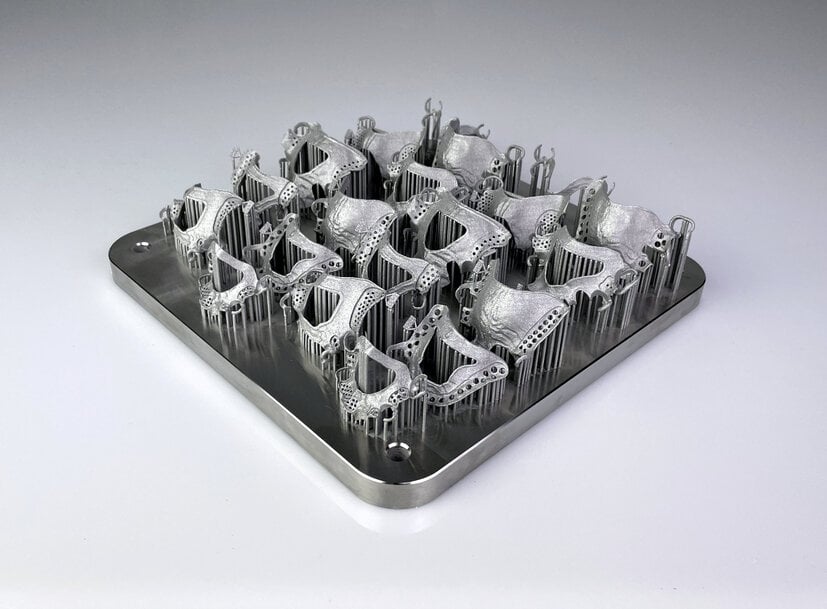
Managing thermal dissipation and residual stresses during laser powder bed fusion represents a persistent bottleneck across critical sectors such as aerospace, automotive, and medical device manufacturing. Software-driven energy modulation allows industrial manufacturers to produce acute overhangs and complex downskin surfaces without relying on dense sacrificial support geometries.
Global engineering technologies company Renishaw has released its LIBERTAS technology, a production-focused software platform engineered to expand geometric freedom, manufacturing throughput, and process scalability across its RenAM 500 series metal additive manufacturing systems. Delivered directly as an upgrade package within the QuantAM build preparation ecosystem, the company plans to provide manufacturers with a software-level solution that operates across existing fleet assets, lowering the cost per part while eliminating the requirement for capital-intensive machine hardware retrofits.
Thermal Management Challenges in Laser Powder Bed Fusion
In conventional metal additive manufacturing, solid support structures are required to anchor components to the build substrate and conduct excess thermal energy away from the melt pool. Without sufficient heat dissipation through surrounding loose powder, localized overheating leads to dross formation, severe geometric distortion, and degraded surface roughness on downward-facing features.
However, excessive support structures introduce major production penalties. They consume non-recoverable alloy powder, extend laser exposure durations, and require complex mechanical or electrical discharge machining post-processing to detach the structures and grind down support witness marks.
Dynamic Laser Modulation and Melt Pool Control
LIBERTAS technology addresses these physical constraints by dynamically adjusting laser parameter delivery across localized part geometries. Rather than applying uniform exposure settings, the software regulates laser power and scan velocities along downward-facing contours and unsupported sections.
By governing thermal input in real time according to local heat dissipation rates, the platform maintains melt pool stability without generating excessive heat buildup. This controlled energy application allows the system to achieve sharper downskin angles, minimize internal thermal stresses, and prevent component warping while preserving structural density and surface integrity.
Operational Integration and Scalable Deployment
The software operates as an integrated module within Renishaw's QuantAM build preparation software. Because it does not depend on dedicated sensor suites or mechanical recoater alterations, the technology deploys into operational facilities without disrupting validated machine settings.
The software utilizes a workstation-level licensing model where build files generated under single QuantAM seats can be distributed across multiple RenAM 500 machines on the production floor. This setup facilitates operational flexibility and predictable repeatability across both single-laser and multi-laser additive manufacturing cells.
"By reducing dependence on support structures, and improving unsupported surface finishes, we are unlocking geometries that were previously unviable due to traditional design for additive manufacturing constraints," stated Benjamin Diaz, Principal Software Product Manager at Renishaw. "We are helping customers improve throughput, reduce waste and decrease cost-per-part — all while using the systems they already have in place."
Industrial Use Cases and Process Validation
Minimizing anchor structures delivers direct production gains in high-value components containing internal channels, fluid passages, and thin-walled housings. In industries ranging from customized medical implants and consumer watch casings to shrouded impellers and aerospace manifolds, the technology prevents the placement of supports in inaccessible internal cavities where mechanical extraction is impossible.
"LIBERTAS technology is designed to support manufacturers across a range of industries, from low-volume, high-value through to full-scale serial production," noted Diaz. "By improving efficiency across the entire AM process, from build preparation to post-processing, the technology helps users achieve more consistent results and greater operational control."
Renishaw presented LIBERTAS technology in operation at Formnext in Frankfurt, held from 17th to 19th November at Stand C11 in Hall 11, demonstrating comparative builds and component quality metrics.
Additional Context:
This section details technical specifications and competitive benchmarking not included in the original product announcement.
Traditional design rules for laser powder bed fusion, codified in standards such as ISO/ASTM 52911-1, typically mandate support structures for overhang angles below 45 degrees relative to the horizontal build plate. Without support, molten metal penetrates the underlying loose powder bed due to capillary action and gravity, causing substantial dross and elevated surface roughness (often exceeding 20 to 30 micrometers Ra). Advanced parameter modulation frameworks such as LIBERTAS push this threshold, enabling stable builds at angles well below 45 degrees without manual support placement.
Within the additive manufacturing landscape, software-led support reduction competes with both hardware-assisted and closed-loop process solutions. Velo3D addresses overhang printing down to horizontal planes using non-contact recoater blades alongside synchronized thermodynamic software, which requires dedicated proprietary machine architectures. Similarly, EOS offers Smart Fusion software, which utilizes thermal simulation algorithms to adjust laser power point-by-point, and Nikon SLM Solutions offers Free Float technology. Renishaw's approach differentiates itself by remaining entirely software-driven within its QuantAM slicing engine, applying dynamic parameter modulation across standard RenAM 500 optical trains to reduce post-machining operations without necessitating custom hardware alterations.
Edited by Natania Lyngdoh, Induportals editor, with AI assistance.
www.renishaw.com
