
metalworkingmag.com
12
'26
Written on Modified on
Caracol brings the robotic manufacturing network to Formnext 2026
See the network at work: robotic platforms for composites and metals, industry leaders reshaping their sectors, and real customer cases from around the world, at Hall 12.1, Booth C129.
www.caracol-am.com
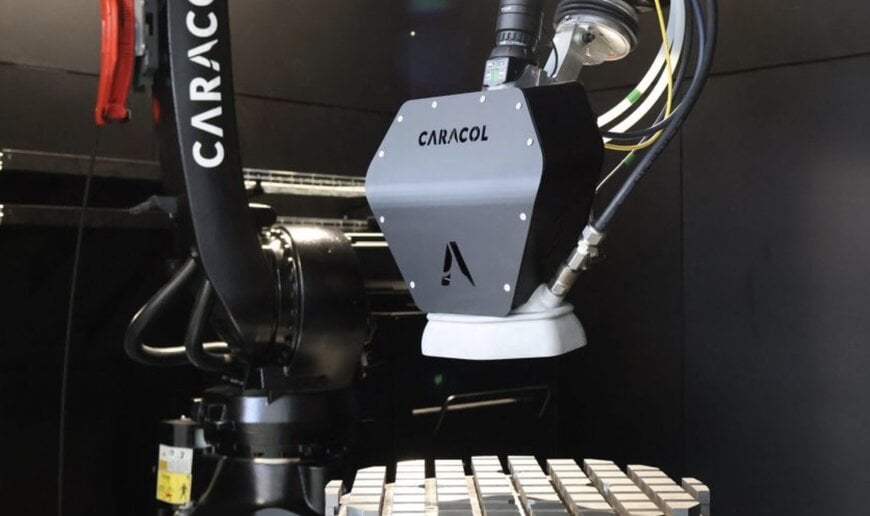
Formnext 2026 takes place from 17 to 20 November 2026 at Messe Frankfurt in Frankfurt, Germany, bringing together industrial 3D printing and automated manufacturing technologies across global supply chains. At Booth C129 in Hall 12.1, Caracol presents turnkey robotic additive platforms and distributed manufacturing workflows engineered for marine, automotive, nuclear, defense, and rail sectors.
Core Technology and System Architecture
The production ecosystem pairs multi-axis robotic deposition platforms with centralized process control software to standardize large-format additive manufacturing (LFAM). Heron AM executes high-output thermoplastic and composite extrusion for large tooling and structural components, while Vipra AM performs robotic wire-arc additive manufacturing for dense metal parts. Both platforms operate under the Eidos Manufacturing software suite, which generates toolpaths, monitors real-time deposition parameters, and logs layer-by-layer build telemetry to enforce repeatable material qualification across distributed hardware nodes.
Deployment or Implementation
The robotic platforms deploy as decentralized microfactories positioned adjacent to end-use assembly lines, shipyards, or regional industrial hubs. Once a component geometry and material profile are validated on a primary cell, the digital build package is replicated across global partner facilities without requiring new foundry tooling or capital-intensive plant construction. Live booth operations demonstrate closed-loop data logging across composite and metal printing cells, supported by multi-partner production runs from JOME Engineering, MTC, Jaguar Land Rover, and Aectual.
Industry Applications
The technologies address long casting lead times, high tooling overhead, and fragile cross-border logistics across heavy industrial manufacturing. Fabricating legacy replacement components or large composite lamination molds via conventional casting and subtractive machining frequently incurs multi-month procurement delays and high transport emissions. Deploying robotic additive cells near the point of consumption eliminates pattern-making steps and enables rapid, near-net-shape production from digital scans or engineering models.
Operational Impact and Performance Metrics
Localized robotic fabrication measurably compresses production schedules and component mass across industrial deployments. In marine operations, JOME Engineering reverse-engineered and printed a replacement propeller in Dubai near the end-user shipyard, reducing lead time by approximately 60 percent and production cost by 40 percent. Using Vipra AM for a legacy metal impeller, MTC reduced production turnaround from several months to roughly one week, cutting lead times by up to 95 percent, costs by up to 70 percent, and component weight by up to 40 percent. In automotive tooling, Jaguar Land Rover produced a patternless car door lamination mold on Heron AM, achieving up to 60 percent weight reduction and 20 percent faster delivery, while Aectual manufactured reusable booth structures from post-consumer recycled polymers.
"Manufacturers are responding by building capacity closer to where parts are needed, and robotics and automation are what make that possible at industrial quality and cost," said Francesco De Stefano, co-founder and CEO of Caracol. "The companies investing in these networks today gain resilience and speed, and they are also building the foundation for physical AI: every platform generates data and a connected network gets better with every part produced."
Edited by Romila DSilva, Induportals Editor, with AI assistance.
www.caracol-am.com
