
metalworkingmag.com
13
'26
Written on Modified on
PcBN Cutting Materials and Five-Edged Cutters for CV Joint Machining
MAPAL FU240 and FU290 grades and five-edged ball track milling cutters raise tool life by over 30 percent.
mapal.com
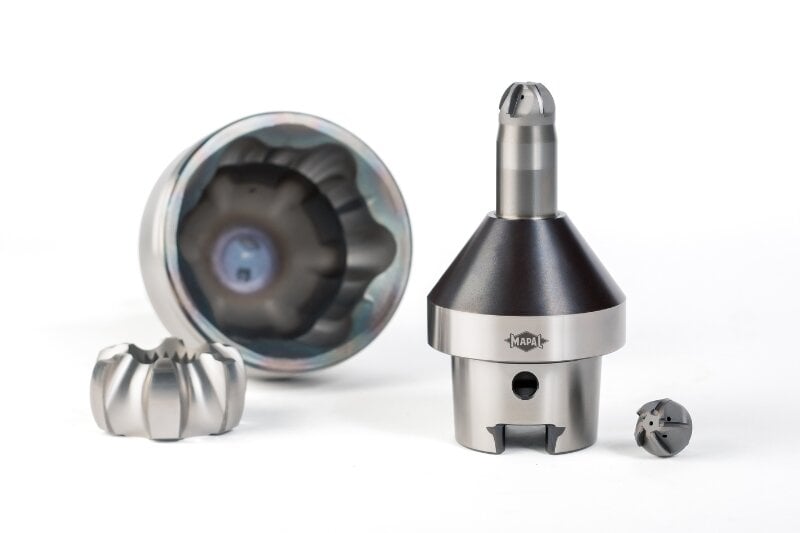
Constant velocity (CV) joints transmit torque from the transmission to the wheels at a constant rotational speed, even when the drive shaft is articulated during steering or suspension travel. Their hardened ball tracks must be machined to tight form and surface tolerances in high volumes. MAPAL has developed new polycrystalline cubic boron nitride (PcBN) cutting materials and a five-edged milling cutter design to increase tool life and reduce machining time in the hard machining of these automotive driveline components.
Hard Machining Requirements for CV Joint Components
Depending on vehicle type, different drive joint designs are used on the wheel side and the transmission side. The main components are the outer race (outer housing), the inner race (ball hub) and the ball cage. The balls run in specially shaped tracks between the inner and outer race and are guided by the cage so that constant rotary motion is maintained at an articulation angle. The ball tracks on both races are hard milled, and the requirements for form and surface quality are very high. The geometry of the milling cutter is therefore decisive, and MAPAL matches its ball track milling cutters precisely to the component tolerances. Tool life, performance and surface quality also depend on the cutting material and the cutting-edge preparation.
Dedicated PcBN Grades for Outer and Inner Races
The two races are produced from different materials: tempered steels for the outer race and usually case-hardened steels for the inner race. While automotive manufacturers follow their own approaches to joint shape and ball guidance, these materials are largely standardised. Because the components differ in machining behaviour and in the wear mechanisms acting on the tool, MAPAL uses different PcBN substrates for each:
- FU240, an uncoated PcBN grade tailored to hard milling the ball tracks of the outer race.
- FU290, an uncoated PcBN grade tailored to hard milling the ball tracks of the inner race.
Tool Life and Cutting Data in Ball Track Milling
In initial results, FU240 and FU290 increased tool life by more than 30 percent compared with previously used cutting materials, at cutting speeds of around 180 m/min and a feed per tooth of 0.07 to 0.10 mm.
Five-Edged Milling Cutter Design Reduces Machining Time
MAPAL is also introducing a five-edged design for its ball track milling cutters. Four-edged designs have so far been the state of the art. The additional cutting edge reduces machining time by around 20 percent compared with a four-edged cutter. It also shortens the engagement time per cutting edge for each ball track, which has a further positive effect on tool life. The tool life gains of the new grades were measured before this design effect was taken into account. With annual production volumes of around 15 million components, the combined effects offer considerable potential to reduce unit costs.
New PcBN Grades for Hard Turning of Drive Joints
New PcBN cutting materials are also being introduced for hard turning, initially for drive joints:
- FP240 for continuous cuts, such as on the shank of the outer race.
- FP260, a more ductile grade for interrupted cuts, such as those on the inner race and the cage.
Additional Context:
This section details technical specifications and competitive benchmarking not included in the original product announcement.
Cubic boron nitride is the second-hardest engineering material after diamond, but unlike diamond it remains chemically stable in contact with iron at high cutting temperatures. This makes PcBN the standard cutting material for machining hardened ferrous materials, typically above around 45 HRC, where hard turning and hard milling can replace or shorten grinding operations. PcBN grades are generally classified by CBN content and binder type. Low-CBN grades with ceramic binders offer higher chemical and thermal stability for continuous cuts, while high-CBN grades provide greater toughness for interrupted cuts. The distinction between continuous-cut and more ductile interrupted-cut grades in MAPAL's turning range is consistent with this established principle. Ball-type CV joints, based on the principle introduced by Alfred Rzeppa in the 1920s, remain the predominant design for front-wheel drive and all-wheel drive vehicles, which explains the high component volumes in this application.
Edited by Natania Lyngdoh, Induportals editor, with AI assistance.
www.mapal.com
