
metalworkingmag.com
16
'26
Written on Modified on
Fronius presents Additive Cell combining welding and automation
The WAAM cell brings together the CMT Additive PRO process, an iWave power source, a Polaris controller and the Vectris software suite.
www.fronius.com
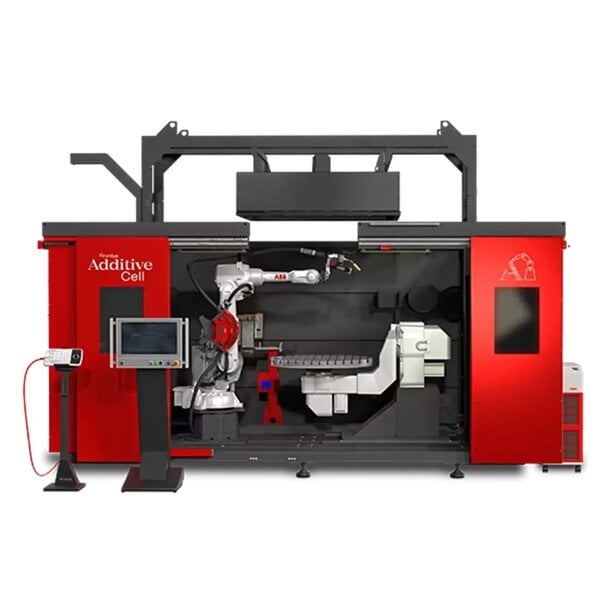
Fronius has presented Additive Cell, a cell dedicated to Wire Arc Additive Manufacturing (WAAM), a metal additive manufacturing process based on arc welding. Intended for producing spare parts, prototypes and complex one-off parts, the cell combines the CMT Additive PRO process, an iWave power source, a Polaris controller and the Vectris software suite to control the manufacture of metal parts. Sectors such as aviation and aerospace, rail, automotive, pressure vessel construction and oil and gas use custom parts and may need spare parts quickly. Metal additive manufacturing produces these components by adding material, without requiring the same moulds or tooling as some conventional processes, which can limit material consumption. According to Manuel Stinglmayr, Business Development at Fronius International GmbH, WAAM enables decentralised, location-independent manufacturing without costly production lines, including for complex geometries.
A stable welding process for regular layers
WAAM requires a stable welding process to ensure that layers are built up evenly. Fronius uses CMT Additive PRO, based on its Cold Metal Transfer (CMT) process. This short-arc process, characterised by limited heat input, enables a high deposition rate compared with other additive processes. Several functions are designed for process control: the deposition rate stabiliser, Pulsed HotStart, CTWD measurement and power correction. Stinglmayr says these functions ensure uniform and predictable layer build-up across the entire part, considerably reducing scrap and the time spent on rework.
Welding and control in one system
In the Additive Cell, the CMT Additive PRO process is combined with the Fronius iWave power source, while the Polaris system controller manages operations. The cell therefore brings welding and the control of manufacturing steps together in a single system. According to Anna Dieplinger, Key Product Manager Additive Manufacturing, Automation & Digital Solutions at Fronius International GmbH, the cell combines proven welding technology, an intelligent control system and Fronius' long-standing welding expertise, with coordinated components for a stable manufacturing process.
The Vectris software suite
The cell also includes Vectris, a software suite developed by Fronius that brings the Machine Tool Service Kit (MTSK) and a post-processor together on one platform. The software incorporates a kinematic model, a user interface and welding operations validated for additive manufacturing. Geometry-based recognition of the different areas of a part allows specific parameters to be defined for outer walls, infills or joints. Integrated into the post-processor, the FroArc control translates these manufacturing strategies, known as Build Styles, into code for the welding robot, which applies the planned parameters to the corresponding areas.
Repair, redesign and services
WAAM applications range from reverse engineering, used for example to repair or reproduce a part when the original or its computer-aided design (CAD) data is no longer available, to redesign, which allows the geometry of an existing part to be modified. At its prototyping and production centre, Fronius offers services ranging from initial consulting and feasibility studies to process development and production. The company also develops, tests and certifies welding parameters suited to the materials used, which can be licensed for production, and can take on process engineering for additive manufacturing projects. The Fronius Additive Cell will be shown at Formnext in Frankfurt am Main from 17 to 20 November 2026, in Hall 12, Stand B59.
Additional Context:
This section explains general principles of wire arc additive manufacturing not included in the original press release.
In WAAM, a robot or machine deposits metal wire melted by an electric arc, bead by bead and layer by layer, to build a part close to its final shape. The part is then usually machined to achieve the required dimensions and surface finish.
Heat from the arc accumulates as the layers build up. If it is not controlled, it can change the width and height of the weld beads and cause distortion. This is why controlling heat input, the distance between the torch and the workpiece, and the deposition rate is important for the geometric accuracy and quality of parts produced by WAAM.
Edited by an industrial journalist, Lekshman Ramdas, with AI assistance.
www.fronius.com
